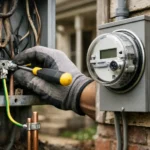
A panel replacement is not a place to buy on appearance, chase the lowest bid, or assume every new panel is an equal upgrade. The best panel brands for home upgrades are the ones that fit the service capacity, available fault current, breaker needs, utility requirements, and future loads of the specific property.
For many East Bay homes, that means more than swapping an old breaker box for a new one. A proper upgrade may involve a 100-amp to 200-amp service change, a new meter-main arrangement, grounding and bonding corrections, AFCI/GFCI protection, and PG&E coordination. The brand matters, but correct design and installation matter just as much.
What Makes a Residential Panel Brand a Good Choice?
A good panel has a strong record in the field, readily available listed breakers, enough physical space for needed circuits, and a product line that supports the way the home will be used. It should also be installed with the manufacturer-approved breakers – not a mix of old, used, or loosely compatible parts.
Homeowners often focus on amp rating. A 200-amp panel is common for a major upgrade, but it does not automatically mean the home needs 200 amps, nor does it guarantee that the service conductors, meter equipment, and utility connection are sized correctly. Load calculations come first. A smaller home with gas appliances may have different needs than a home adding an EV charger, induction range, heat pump, air conditioning, and an accessory dwelling unit.
For older Oakland, Berkeley, Piedmont, and Lafayette properties, panel replacement is also frequently a safety correction. Federal Pacific/Stab-Lok equipment, Zinsco panels, fuse panels, damaged bus bars, corroded equipment, and overloaded subpanels deserve a closer look. A respected new panel brand cannot compensate for faulty wiring, a bad service connection, or missing grounding.
Best Panel Brands for Home Upgrades
Square D QO: A Premium Choice for Long-Term Service
Square D QO is one of the strongest choices for homeowners who want a high-quality, widely recognized residential panel. The QO line has a long track record, a broad range of breaker options, and an indicator feature on many breakers that can help identify a tripped breaker condition. It is commonly selected for higher-end renovations, major service upgrades, and homes where long-term parts availability is a priority.
The trade-off is cost. QO equipment generally costs more than basic residential panel lines. That higher price can make sense when the project is already substantial, especially if the homeowner expects to add EV charging, solar, battery storage, or major electric appliances later.
Square D Homeline is a different product line. It can be a practical, cost-conscious choice for many homes, but its breakers are not interchangeable with QO breakers. The panel and breaker family must match exactly.
Eaton CH: Strong Construction and a Premium Breaker System
Eaton CH panels are another premium residential option. They are known for their distinctive tan breakers and a solid reputation among electricians and homeowners. The CH line is often chosen for major remodels and higher-value homes where the owner wants durable, established equipment.
Eaton also makes the BR line, which is more common in many standard residential installations. BR can be a good, economical system when properly specified. As with Square D, however, CH and BR are separate product families. A breaker that physically fits is not necessarily listed or approved for that panel.
For a homeowner comparing bids, the right question is not simply, “Is it Eaton?” Ask which Eaton series is being installed, how many spaces it provides, whether it includes the required protective breakers, and whether expansion capacity is built into the quote.
Siemens: Practical, Proven, and Widely Used
Siemens is a dependable choice for many standard residential panel replacements and service upgrades. Its equipment is widely used, parts are generally accessible, and its breaker line supports the AFCI, GFCI, and dual-function protection required in many modern applications.
Siemens is often a sensible fit where the project needs reliable listed equipment without moving to the higher price point of some premium panel lines. It is particularly useful when an electrician is matching an existing Siemens subpanel or planning a straightforward main panel replacement.
The key is still proper sizing. A panel with plenty of circuit positions may be a better choice than a cramped panel that appears less expensive on day one. Homeowners adding a 240-volt EV charger circuit, electric dryer, heat pump, or kitchen circuits can run out of room faster than expected.
Leviton: Best for Homeowners Who Want Smart Monitoring
Leviton load centers are a newer option compared with the long-established Square D, Eaton, and Siemens systems. Their appeal is flexibility, especially for homeowners interested in smart breakers, circuit-level monitoring, and remote visibility into electrical use.
That can be useful for a rental property, a second home, or a homeowner tracking an EV charger, solar production, or unusually high energy consumption. Smart features can provide useful information, but they should not be confused with electrical safety by themselves. A monitoring app does not fix an undersized service, a loose connection, or aging branch wiring.
Leviton can be an excellent fit when smart management is a real goal. If the priority is a conventional, proven panel replacement with readily familiar components, Square D, Eaton, or Siemens may be the more straightforward choice.
Do Not Choose a Panel Brand by Price Alone
The panel is only one part of the job. A low panel quote sometimes leaves out work that is necessary for a safe, permitted upgrade: service entrance conductors, meter equipment, grounding electrode conductors, bonding, weatherhead work, trenching, utility coordination, or required breakers.
A new panel may also reveal issues outside the panel. In older homes, branch circuits can have damaged insulation, open grounds, ungrounded outlets, double-tapped breakers, oversized breakers, knob-and-tube wiring, or aluminum wiring that needs special attention. These conditions should be evaluated before the cover goes back on.
It is also worth avoiding obsolete or questionable equipment, even if someone offers a cheap replacement breaker online. Federal Pacific/Stab-Lok and Zinsco equipment have serious safety concerns and are commonly identified during real estate inspections. Reconditioning an unsafe panel is not the same as replacing it. Used breakers, counterfeit breakers, and breakers from another manufacturer are not a sound solution either.
Panel Size, Spaces, and Future Electrical Loads
The best brand is the one that leaves room to grow. A homeowner may only need a few new circuits today, but electrical demand is changing quickly. Electric vehicles, heat pumps, induction cooking, electric water heaters, solar systems, batteries, and ADUs all require planning.
A properly planned 200-amp upgrade should consider both electrical load and physical breaker space. These are different issues. A home can have enough service capacity but no room in the panel for another two-pole breaker. It can also have a large panel with many open spaces but insufficient calculated service capacity for a major new load.
For EV charger work, a load calculation can determine whether the home needs a service upgrade, a managed charging solution, or simply a correctly sized dedicated circuit. Guessing creates expensive surprises after drywall is opened or permits are submitted.
Ask These Questions Before Approving a Panel Upgrade
Before signing an estimate, ask what panel series will be installed, whether it is a main panel or subpanel, how many spaces are included, and what breakers are included in the price. Ask whether the work includes permits, inspection, grounding and bonding corrections, and coordination with PG&E when a service change is involved.
Also ask whether the electrician found signs of overheating, corrosion, damaged bus bars, unsafe legacy equipment, or overloaded circuits. A qualified electrician should be able to explain the condition in plain language and identify what is urgent versus what can be planned for later.
For homeowners replacing a Federal Pacific, Zinsco, or fuse panel, the goal is not to pick the flashiest nameplate. The goal is a properly engineered, code-compliant electrical system with the capacity and protection the property actually needs. That is the kind of panel upgrade that protects the home long after the inspection sticker is issued.