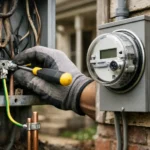
A lot of these high pg&e bills are due to faulty smart meters, and chicken wire stucco short circuits that drain power due to resistant load. Some devices claim to be able to reduce the bill by 30% and more. A lot of high electric bills send people looking for a trick. That is usually what is behind questions like, “Are there any devices I can use to lower my electricity bill? Can I make an aluminum foil ball and place it against the main feeder hot wires inside the panel? Can I use one of these watt stopper devices that claim to reduce inductive load, ie, to motors, led transformers? Can I wrap a plastic bag around the meter itself? What if any trick of the trade can I use to lower my bill?” The short answer is this: there is no safe trick inside the panel or at the meter that will legally reduce your bill. Some of those ideas are dangerous, some are utility tampering, and some are flat-out scams.
Are there any devices I can use to lower my electricity bill?
There are only a few categories of devices that genuinely lower an electric bill. They do it by reducing actual power use, shifting when power is used, or improving control of equipment. They do not “confuse” the meter, offset incoming power, or magically cancel out the bill.
A legitimate energy-saving device is something like a smart thermostat, occupancy sensor, heat pump water heater, variable-speed pool pump, or a properly selected LED retrofit. In some homes, an EV charger with load management or scheduled charging can also reduce costs if the utility rate plan rewards off-peak use. These devices save money because they reduce kilowatt-hours or demand during expensive periods.
What does not belong in that category are plug-in boxes sold as “power savers,” “watt stoppers,” or “electricity stabilizers” that promise major savings for the whole house. Most of those claims do not hold up in a typical residence.
The aluminum foil idea is dangerous and can start a fire
Putting an aluminum foil ball against the main feeder hot wires inside a panel is not a hack. It is a serious shock hazard, arc hazard, and fire hazard.
Inside a service panel, those feeder conductors are energized at very high fault current. If metal bridges conductors or contacts energized parts and grounded metal, the result can be arcing, equipment destruction, severe burns, or death. Even experienced electricians treat service equipment with caution because the available fault current can be tremendous.
There is another issue. Any attempt to interfere with service conductors is not energy management. It is tampering with electrical equipment. That can damage the panel, destroy the meter, and create a condition that puts everyone in the building at risk.
If your bill is high, the panel is the last place to improvise. A panel is for safe distribution, overcurrent protection, grounding, and code-compliant connections. It is not a place for experiments.
Wrapping a plastic bag around the meter will not help
Wrapping a plastic bag around the electric meter will not lower consumption. A modern meter records usage electronically or mechanically based on actual current and voltage. A plastic bag does not stop that.
What it can do is create moisture problems, trap heat, interfere with visibility, and raise questions about meter tampering. In some cases, anything placed over a utility meter can violate utility rules. It is simply not worth the risk.
If there is concern that the meter is inaccurate, the right move is to contact the utility and ask about meter testing procedures. That is the lawful path. Guesswork and meter interference are not.
Do watt stopper devices reduce inductive load?
This is where the advertising gets just technical enough to sound convincing. Some products claim to reduce inductive load from motors, transformers, refrigerators, air conditioners, pumps, or LED drivers by correcting power factor. That sounds sophisticated, and in certain commercial or industrial settings, power factor correction is a real thing.
But in most homes, it does not translate into the kind of savings those products promise.
Residential customers are usually billed for real energy use in kilowatt-hours, not for reactive power the way some large commercial customers may be. So even if a device slightly improves power factor on a motor load, that does not necessarily reduce the homeowner’s bill in a meaningful way.
There are also practical limits. Many modern appliances already include their own controls and efficiency design. LED lighting drivers vary. Motors cycle on and off. Load conditions change constantly. A one-size-fits-all box plugged into a receptacle or mounted near a panel is rarely doing what the sales pitch suggests.
That is why the honest answer is: maybe there are narrow technical cases where a specific correction method helps a specific load, but for the average house, these devices are usually oversold and underperforming.
What actually causes high electric bills
Before buying a gadget, it pays to identify where the power is going. In older East Bay homes, the biggest drivers are often not exotic. They are the same basic loads seen over and over: electric water heaters running too much, old refrigerators in garages, baseboard heat, space heaters, pool equipment, aging HVAC systems, attic fans, dehumidifiers, and people charging vehicles without paying attention to rate schedules.
Then there are hidden issues. A failing well pump, a stuck heating element, an air handler with a bad control, a damaged underground feeder to an outbuilding, or poor wiring splices causing heat can all create waste or abnormal usage. I have also seen properties where tenants added loads the owner did not realize were there, including extra refrigeration, server gear, or portable AC units.
High bills can also show up after electrical upgrades for a simple reason: the problem was never the panel. The old panel may have been unsafe and needed replacement, but the usage problem was actually HVAC, water heating, or an appliance fault.
The real tricks of the trade that work
There are tricks, but they are not tricks in the panel. They are diagnosis and control.
Start with the bill itself. Look at total kilowatt-hours month to month. Then compare seasonally. If the usage jumps suddenly without a clear reason, something changed. That change could be weather, occupancy, a failed appliance, or a billing issue.
Next, isolate circuits. A clamp meter and real load testing can show what major circuits are drawing. For example, an electric water heater can be checked to see whether an element is stuck on too long. HVAC loads can be measured. Subpanels can be tested. This is real troubleshooting, not guessing.
If the home has an old panel, loose connections, overheating breakers, aluminum branch wiring issues, or improper neutral and grounding conditions, those should be corrected for safety first. Safety repairs do not usually slash the bill by themselves, but bad electrical conditions can damage equipment and create abnormal operation.
After that, the best savings usually come from a handful of practical corrections:
- Replace old resistance heating habits with better controls or better equipment.
- Set water heater temperature correctly and verify the thermostat and elements are working normally.
- Remove unnecessary always-on loads like old garage refrigerators or unused commercial gear.
- Use timer control for exterior lighting, bathroom heaters, and recirculation pumps.
- Evaluate pool pumps, EV charging schedules, and HVAC runtime.
- Upgrade lighting where old high-wattage fixtures still exist.
That is where savings are found. Not in a magic box.
If you want a device, use one that measures or controls
The best device for lowering a bill is often a monitor, not a saver. Circuit monitoring or whole-home energy monitoring can help identify what load is driving the bill. Once you know that, you can decide whether the fix is behavioral, mechanical, or electrical.
Control devices also help. Smart thermostats, timer switches, occupancy sensors in the right locations, photocells for exterior lights, and EV chargers set to off-peak hours can all make a real difference. They work because they manage actual runtime.
There is a trade-off, though. Not every smart device is worth installing. In a small house with simple usage patterns, the savings may be modest. In a larger home, rental property, or mixed-use building with more equipment, controls can pay off faster.
When a high bill is really an electrical service issue
Sometimes the question about lowering the bill comes from a homeowner who is also dealing with an old Federal Pacific, Zinsco, or fuse panel. Those systems should be evaluated because they can be unsafe, especially if there are signs of overheating, double taps, corrosion, or improper additions.
But replacing a dangerous panel is a safety and reliability job, not a bill-reduction gimmick. A new 200-amp panel upgrade can give you proper breaker protection, capacity for EV charging, cleaner distribution, and code-compliant grounding. What it will not do is magically cut energy consumption unless part of the old problem involved a failing piece of equipment operating incorrectly.
That distinction matters. A homeowner should not be sold a panel change as an energy saver unless there is a real technical basis for that claim.
The safest answer to “What can I do right now?”
If your electric bill suddenly spiked, the smart move is to check for changed usage, compare bills, and have the major loads tested. If you are considering anything that touches the panel, feeders, or meter, stop. That is not do-it-yourself territory.
A licensed electrician can determine whether the problem is load-related, equipment-related, or service-related. In some cases, the answer is as simple as a failed water heater thermostat. In others, it is an overloaded subpanel, a bad connection, or a property with old unsafe electrical gear that needs correction. Geoff Williams has been handling this kind of electrical troubleshooting and panel work for decades, and the right diagnosis usually saves more money than any gadget ever will.
The useful trick of the trade is not how to fool the meter. It is knowing exactly what is using power, fixing what is wrong, and keeping the electrical system safe while you do it.