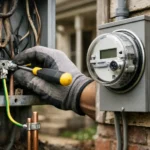
Dead power is rarely random. When a receptacle stops working, a light goes out, or part of a circuit dies, there is almost always a reason – and a good electrician does not guess. If you are asking, “How does an electrician use logic to trouble shoot dead power in my outlet, my light, my circuit?” the short answer is this: by tracing the path of power, narrowing the fault, and testing each point in order. In electrician land, we often have to admit, that we were completely wrong about a series of assumption. It’s not easy to admit that you were stupid and a fool. When we ignore our experience, in favor of wrongness, that can be very bad.
That matters because electrical troubleshooting is not just about getting the lights back on. In older homes, especially the kind found throughout the East Bay, dead outlets and dead lighting circuits can point to loose backstab connections, failed GFCIs, damaged switches, overheated splices, bad breakers, multiwire circuit issues, or older panels that should have been replaced years ago. The right fix depends on finding the actual failure point.
How an electrician thinks through dead power
An experienced electrician starts with a simple question: what still works, and what does not? That sounds basic, but it is the first step in narrowing down the problem. If one outlet is dead but the rest of the room works, the fault is usually local to that outlet or to a device feeding it upstream. If half the room is dead, or several outlets and lights went out together, now the electrician starts thinking circuit-level problem, lost connection, tripped protection device, or failed breaker.
The logic is similar to following a water line. Power leaves the panel, travels through a breaker, moves along the branch circuit, and passes through switches, splices, receptacles, GFCIs, and fixtures. It stops wherever the connection fails. The job is to find the last point where power is good and the first point where power is lost.
That is why electricians test in sequence instead of opening every box in sight. Randomly replacing outlets or switches wastes time and can miss the real fault.
Start at the panel, but do not stop there
The electrical panel is the first checkpoint because it tells you whether the circuit is getting power at all. A breaker may be tripped, weak, or internally failed. In some cases, especially with older Federal Pacific, Zinsco, or worn breaker systems, the handle position does not tell the full story. A breaker can look on and still fail to deliver proper voltage.
A licensed electrician checks the breaker mechanically and electrically. That means resetting it if appropriate, then testing for voltage leaving the breaker. If voltage is correct there, the fault is downstream. If voltage is missing or unstable at the breaker, now the problem may be in the panel itself, at the breaker connection, the bus, or the feeder conditions supplying that panel.
This is where experience matters. Dead power can be a branch circuit problem, but sometimes it is a symptom of a larger service or panel issue.
A dead outlet is often fed through another device
Homeowners often assume the dead outlet itself is bad. Sometimes that is true, but not always. Many receptacles are fed from another receptacle, switch box, or GFCI upstream. So the dead outlet may only be the point where the problem becomes visible.
An electrician will identify which device is likely first in the circuit run and which ones are downstream. Then the testing starts at the live side and moves toward the dead side. If one outlet has power on the line side but not on the load side, that device or splice is a prime suspect. If voltage enters a box but does not leave, the fault is there. If voltage never arrives, the electrician moves one step back.
Loose push-in connections are a common cause, especially in older production work and quick remodel jobs. Burned terminals, broken tab connections, failed GFCIs, and overheated wirenut splices are also common. In kitchens, baths, garages, basements, exterior circuits, and some laundry areas, a tripped GFCI can shut off multiple outlets that do not look like GFCI outlets at all.
How an electrician troubleshoots a dead light
Lighting problems follow the same logic, but the switching adds another layer. If a light is dead, the electrician needs to know whether power is missing at the fixture, missing at the switch, or blocked by a failed switch leg, dimmer, photocell, timer, or internal fixture issue.
The first question is whether the lamp or fixture itself has failed. That is the obvious part. After that, the electrician checks whether the switch box has constant power, whether the switched conductor changes state properly, and whether neutral is intact at the fixture.
A dead light with a good hot but an open neutral can fool people. So can a failed dimmer. So can a switch loop in an older home where the wiring colors do not match modern expectations. This is why proper testing beats visual guessing.
If several lights are out together, the electrician starts looking for a shared junction box, a tripped GFCI feeding a lighting leg, or a loose splice in an attic, crawlspace, or ceiling box. In older homes with prior handyman work, mixed wiring methods and hidden splices are not unusual. That changes the troubleshooting path fast.
Dead circuit logic: find the last working point
When an entire circuit or half a circuit is dead, electricians narrow the problem by mapping what is still energized. The pattern tells a story. If the first two receptacles work and everything after that is dead, the failure is usually between the last working device and the first dead one. If both the light and receptacles in one area are out, they may share a feed-through splice or a failed device box.
This is where field logic is more valuable than theory. The electrician is not just testing voltage. He is reading the layout of the house, the age of the wiring, the quality of prior work, and the type of panel protection involved.
For example, if a bedroom circuit is dead and protected by AFCI, the issue may be nuisance tripping, a weak breaker, or an actual arc fault. If an outdoor or bathroom circuit is dead, GFCI protection is high on the list. If only one leg of a 120/240 system is lost, multiple circuits may show strange symptoms at once, including dim lights, dead receptacles, and appliances acting erratically. That is no longer a simple outlet problem.
Tools matter, but the sequence matters more
Electricians use testers, meters, plug analyzers, continuity checks, and sometimes circuit tracers. But the tool is only as good as the logic behind it. A non-contact tester may show presence of voltage, but it does not tell you whether the circuit can carry load. A meter can show 120 volts from hot to ground and still miss an open neutral problem if you do not test hot to neutral as well.
That is why experienced troubleshooting is methodical. Verify power source. Verify breaker output. Identify the circuit path. Test line and load sides. Check hot, neutral, and ground relationships. Isolate the failure point. Repair the connection. Retest under load.
Skipping steps causes misdiagnosis. So does replacing parts because they are easy to replace.
Why dead power can point to a safety problem
Not every dead outlet or dead light is dangerous, but some are warning signs. A loose connection creates heat. Heat damages devices, insulation, and terminals. That can lead to burned outlets, failed breakers, damaged conductors, and in the worst cases, fire risk.
If the dead power started after you smelled something burning, heard buzzing, saw flickering, or noticed warm outlets or panel components, that changes the urgency. The same is true if your home has older aluminum branch wiring, knob-and-tube remnants, fuse protection, or obsolete panel equipment.
In those cases, troubleshooting is not just about restoring power. It is about finding out why the connection failed and whether the repair belongs at the device, the splice, the breaker, or the panel. Sometimes the outlet is the symptom and the panel is the problem.
When a pro is worth calling right away
You can check for a tripped breaker and reset visible GFCIs. Beyond that, dead power should be handled carefully, especially if the failure affects multiple rooms, involves an older panel, or keeps coming back after resets.
A licensed electrician brings a process. He does not just swap a breaker and leave. He checks whether the circuit is overloaded, whether terminations are damaged, whether code-required GFCI or AFCI protection is missing, and whether the issue connects to a larger service defect. That is especially important in older Bay Area homes where remodels from different decades often leave mixed wiring methods behind walls.
At Williams Electric, this kind of troubleshooting is treated as inspection-driven repair work, not guesswork. That is the difference between restoring temporary power and fixing the actual failure.
If your outlet, light, or circuit is dead, the logic is simple even when the wiring is not: find where power starts, find where it stops, and identify why it stopped there. Good electricians follow that path carefully, because the right answer is usually hidden one connection before the place that went dark.