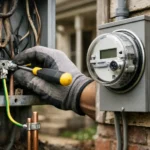
I have in electrician land,seen many 14/50 outlets feeding ev chargers catch fire. I have never seen a hard wired level two charger catch fire. A homeowner buying an EV often asks for a “charger outlet,” then discovers there are two very different jobs: installing a NEMA 14-50 receptacle for a portable charging cord or installing a hardwired Level 2 EV charger. The EV charger vs 14-50 outlet decision affects charging speed, reliability, cost, panel capacity, and how well the installation will hold up over years of daily use.
For many East Bay homes, especially older homes in Oakland, Berkeley, and Piedmont, the first question is not which option costs less. It is whether the existing electrical service, main panel, grounding, and available load can safely support the new continuous electrical load. A proper answer starts at the panel, not in the garage.
EV Charger vs 14-50 Outlet: The Basic Difference
A 14-50 outlet is a 240-volt, 50-amp receptacle. It is commonly used for electric ranges, RVs, welders, and portable EV charging equipment. Many Tesla and other EV owners use a plug-in mobile connector with a 14-50 adapter. The receptacle provides the power source, while the portable cord set manages the charging process.
A hardwired EV charger, more accurately called EV supply equipment or EVSE, is permanently connected to a dedicated circuit. It may be mounted on a garage wall, exterior wall, carport post, or parking area near the vehicle. The EVSE communicates with the car and safely controls the charge current.
Both can deliver Level 2 charging. The difference is not simply “slow outlet” versus “fast charger.” A 14-50 circuit can charge an EV very well. The real differences are continuous-duty reliability, maximum available amperage, convenience, and the quality of the equipment and wiring behind the installation.
Charging Speed Depends on Circuit Size and the Vehicle
EV charging is considered a continuous load because it can run for three hours or more. Electrical code requires the circuit to be sized at 125% of the charging load. That means a 50-amp circuit is normally limited to 40 amps of continuous EV charging.
A correctly installed 14-50 outlet on a 50-amp dedicated circuit will generally support a 40-amp charging setting. That is plenty for many drivers, often adding roughly 25 to 30 miles of range per hour, depending on the vehicle. The exact result depends on the vehicle’s onboard charging capacity, battery condition, and other losses.
A hardwired unit can be sized higher when the house and equipment allow it. For example, a 48-amp EVSE typically requires a 60-amp circuit. Some vehicles cannot accept 48 amps, while others can. There is no benefit in paying for a larger circuit if the vehicle or charger is limited to 32 or 40 amps.
For most homeowners who drive a normal daily commute, 32 or 40 amps overnight is more than adequate. Higher-power charging is most useful for households with multiple EVs, high daily mileage, short overnight charging windows, or a vehicle that returns home nearly empty and must be ready again quickly.
Why Hardwired EV Chargers Are Usually More Reliable
A hardwired EV charger eliminates one major weak point: the plug and receptacle connection. EV charging places a high load on that connection for long periods, often every night. Heat at a loose, worn, poorly installed, or low-quality receptacle can damage the outlet, melt the plug, trip the breaker, or create a fire hazard.
This does not mean a 14-50 outlet is automatically unsafe. A properly installed receptacle, correct wire size, correct breaker, torque-checked connections, suitable box, and appropriate charging setting can provide dependable service. But it needs to be treated as a continuous-duty EV circuit, not as a basic range outlet installation.
Hardwired equipment has fewer parts that can loosen over time. It also allows for higher charging rates without relying on a receptacle and plug. For a permanently parked vehicle that charges most nights, hardwiring is usually the cleaner long-term installation.
A hardwired unit may also provide useful features, such as scheduled charging, energy monitoring, access control, and load management. Those features matter when utility rates vary by time of use or when two EVs share limited electrical capacity. They are conveniences, however, not substitutes for proper circuit and panel work.
When a 14-50 Outlet Makes Sense
A 14-50 outlet remains a reasonable choice in certain situations. It works well when an owner already has a quality portable EV charging cord, wants to take that charger while traveling, or has an EV that will only use 32 or 40 amps anyway.
It can also be practical in a rental property or a home where the owner has not decided which EVSE brand or vehicle they will keep long-term. The receptacle provides flexibility, provided the installation is built correctly for EV use.
The trade-off is that the outlet and plug must be inspected periodically. If the plug feels unusually hot, the outlet is discolored, the cord fit becomes loose, or the breaker trips during charging, stop using it and have the circuit checked. Those are not normal signs of “heavy use.” They are warning signs that need attention.
A 14-50 outlet should not share a circuit with an electric range, dryer, workshop equipment, or any other load. EV charging requires its own dedicated branch circuit. Extension cords, adapters of questionable quality, and improvised exterior connections are not acceptable solutions.
The Panel Capacity Question Can Change Everything
A garage may have physical space for a new breaker while the electrical service lacks sufficient capacity for an EV load. Those are separate issues. An electrician needs to perform a load calculation based on the home’s service size and actual or calculated loads, including electric cooking, HVAC, water heating, laundry, and the new EV circuit.
Older East Bay houses commonly have 100-amp services, undersized panels, obsolete fuse equipment, or panels with known safety concerns. Federal Pacific, Zinsco, damaged bus bars, double-tapped breakers, and missing grounding corrections should not be ignored just because the immediate goal is EV charging.
In some homes, a 40-amp EV circuit can be added safely without a service upgrade. In others, the right answer is a 200-amp panel upgrade, a service change coordinated with PG&E, or a load-management system that reduces charging current when the home demand is high. The correct answer depends on the specific house.
This is where experience with older electrical systems matters. Adding a large continuous load to a compromised panel is not a shortcut. It is a way to turn a small issue into an expensive one.
Permits, GFCI Protection, and Outdoor Installation Details
EV circuit requirements can vary by the adopted electrical code and local authority having jurisdiction. Permit requirements are common for new 240-volt EV circuits, and an inspection helps verify wire sizing, breaker sizing, grounding, routing, box fill, and equipment location.
For receptacle installations, GFCI protection may be required under current code rules. That can create compatibility issues with certain portable EV cords, especially older equipment that has its own ground-fault detection. The answer is not to remove safety protection or install an oversized breaker. The equipment, circuit design, and local code requirements need to be evaluated together.
Outdoor charging adds another layer. The EVSE or receptacle must be rated for the location, protected from physical damage, and installed where the cord can reach the vehicle without crossing a walkway or driveway. Conduit type, weatherproof covers, mounting height, and trench depth all matter. A neat-looking exterior installation can still be wrong if the materials are not listed for wet locations or the wiring is exposed to damage.
Cost: Cheaper Up Front vs Better for Daily Use
A 14-50 outlet may cost less initially because the owner supplies the portable charger and the electrician installs a receptacle rather than a wall-mounted EVSE. But the circuit cost is often similar. Both options require a dedicated 240-volt circuit, properly sized copper conductors, a breaker, routing from the panel, and permit work where required.
The real price difference comes from distance, access, panel condition, trenching, drywall repair, and whether a service upgrade is necessary. A short run from a modern panel to an attached garage is very different from a long underground run to a detached parking space behind an older home.
For a homeowner who will charge one car every night for years, the hardwired charger is commonly the better value. For someone who wants portability or plans to move soon, a correctly installed 14-50 outlet can be the sensible choice.
A Practical Way to Choose
Choose a hardwired EV charger when you want the highest practical charging rate, a permanent daily-use setup, fewer plug-related failure points, or smart charging features. It is usually the stronger choice for a primary residence and a vehicle that stays parked in the same place.
Choose a 14-50 outlet when portability matters, your vehicle and charging cord are already limited to 40 amps or less, or you want flexibility before selecting a permanent EVSE. Do not choose it solely because it appears to be a simple outlet job.
Before either installation, have the panel, service capacity, existing wiring condition, and proposed charger location evaluated. Williams Electric has handled electrical service and EV circuit work in older East Bay homes for decades, where the condition of the existing system often determines whether a simple installation is truly safe. The best charging setup is the one that matches your vehicle, driving habits, and electrical system without overloading any part of the home.