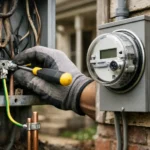
Insurance companies won’t cover glass or any fuse panels in your house now. If you are searching for how to replace fuse box equipment, you are probably dealing with an older property, a failed inspection, or a panel that has started showing its age in ways that should not be ignored. A fuse box is not just old hardware on the wall. It is the center of the electrical system, and when it is outdated, undersized, damaged, or modified over the years, replacement becomes a safety job, not a handyman project.
That is the first thing to get straight. In many homes, what people call a fuse box replacement is really a service panel upgrade. The old fused disconnect may need to be removed, the service entrance may need correction, grounding and bonding may need updates, and the utility coordination may need to be handled properly. If the house still has old branch wiring, double-tapped fuse adapters, oversized fuses, corrosion, heat damage, or missing knockouts, the scope gets bigger fast.
What replacing a fuse box really involves
A true fuse box replacement means taking an outdated fused panel out of service and installing a modern circuit breaker panel that meets current code requirements for the property. That usually includes a new main breaker, new bus bars, properly sized breakers, labeling, grounding electrode connections, bonding corrections, and in many cases AFCI or GFCI protection where required.
On older homes, it may also include meter work, service mast or weatherhead repair, conduit replacement, or underground service coordination. That is why the answer to how to replace fuse box equipment is rarely just, “remove the old box and put in a new one.” The panel has to match the service size, the load, the existing circuits, and the utility requirements.
A small one-story house with modest loads may be able to move from a fuse box to a 100-amp breaker panel if the service is otherwise in good condition. But a lot of East Bay homes benefit more from a 200-amp panel upgrade, especially if the owner plans to add air conditioning, induction cooking, an EV charger, or laundry upgrades. The right answer depends on the load calculation, the condition of the existing service, and the future use of the building.
Why old fuse boxes get replaced
Fuse boxes are not automatically dangerous just because they are old, but many of the ones still in service have been altered, overloaded, or neglected. Homeowners and landlords often find the problem after a home inspection, insurance question, recurring outage, or a hot panel smell.
The most common trouble is not the concept of a fuse itself. The real problem is what happens over decades. People install incorrect fuse sizes. They use adapters to stop nuisance blowing. They add circuits without enough capacity. Terminations loosen. Moisture gets in. The box may not have a proper main disconnect. At that point, replacement is usually safer and more cost-effective than piecemeal repair.
Another reason is practical. Fuse boxes are not designed for the electrical demand of a modern household. Between kitchen circuits, computers, space heaters, microwaves, EV charging, and added appliances, the old equipment runs out of room and out of capacity.
How to replace fuse box equipment the right way
For a licensed electrician, the basic sequence is straightforward, but the details matter. First comes an inspection of the existing service. That means checking the service size, condition of conductors, grounding, bonding, meter setup, branch circuit layout, physical damage, and code issues that will need correction during the changeout.
Next comes load planning. There is no point installing a new panel that is already too small. If the property is going to need a future EV charger, heat pump, subpanel, or remodel, that should be accounted for now. A panel replacement is the time to fix undersizing.
After that, permits and utility coordination are usually required. The power has to be disconnected safely. Depending on the property, this may involve the utility, the city, and inspection scheduling. In some cases, temporary outage planning matters, especially for occupied rentals or small commercial spaces.
Then the old fuse box is removed and the new panel is installed. Each branch circuit gets identified, landed properly, protected with the correct breaker, and labeled. Grounding and bonding get brought up to standard. If there are damaged conductors, shared neutrals, deteriorated insulation, or unsafe splices near the panel, those should be corrected as part of the work.
Finally, the system is tested, inspected, and re-energized. A clean panel replacement should leave the customer with a safer service, a clearly labeled panel, and enough capacity for present use and near-term upgrades.
Why this is not a DIY job
People still ask if they can learn how to replace fuse box equipment on their own and save money. The short answer is that this is one of the worst places to experiment. Even with the main disconnected, parts of the system may remain energized until utility disconnection is handled correctly. Service conductors can kill you. A bad termination can overheat slowly and fail later. A grounding or bonding mistake can create shock hazards that are not obvious right away.
There is also the permit and inspection side. In most cases, electrical service equipment replacement is not a casual repair. It needs to be done to code, inspected, and documented correctly. If a fire, injury, insurance claim, or sale issue comes up later, unpermitted panel work can become an expensive problem.
This is especially true in older Bay Area housing stock, where panel replacements often uncover cloth wiring, improper neutrals, missing grounds, old subpanel bonding errors, or previous unlicensed work. What starts as a panel change can turn into a correction job that needs experienced judgment.
What can change the cost and scope
No honest electrician should quote every fuse box replacement as if they are all the same. Some go smoothly. Some turn into service rebuilds.
The biggest variables are service size, panel location, whether the meter and service entrance need replacement, how many circuits exist, and whether grounding upgrades are required. If the old panel is recessed in finished walls, if conductors are too short, or if the utility connection is outdated, labor goes up. If the house has enough slack, a clean layout, and good service conductors, the job is simpler.
Future needs matter too. If a homeowner is planning to install an EV charger in a year, it often makes sense to size the panel for that now instead of paying twice. The cheapest option today is not always the lowest total cost.
Signs you should replace the fuse box soon
If fuses blow repeatedly, lights flicker under load, the panel feels warm, or there is visible rust, scorching, or cracking, do not wait around hoping it settles down. The same goes for a panel that has no main disconnect, has obvious overfusing, or cannot support basic modern circuits safely.
A failed real estate inspection is another common trigger. Buyers, sellers, and agents run into this all the time. An old fuse box can complicate financing, insurance, and closing timelines. Replacing it before the deal gets stuck is usually the cleanest move.
Landlords should pay attention as well. Tenant load patterns are different than they were decades ago. Portable AC units, heaters, and kitchen appliances stress small old services hard, and nuisance failures tend to become emergency calls at the worst time.
Choosing the right electrician for fuse box replacement
This is a job for a licensed, bonded, and insured electrician who does panel changes regularly, not somebody who mostly installs light fixtures and takes panel jobs occasionally. Ask whether they handle service upgrades, permit work, utility coordination, grounding corrections, and older home troubleshooting. If they hesitate, keep looking.
Experience matters because old panels rarely come with perfect conditions. The electrician needs to recognize hidden defects, make safe field decisions, and keep the job moving without cutting corners. That is one reason many local homeowners, real estate agents, and contractors call Williams Electric for fuse box and panel replacement work. This type of service is technical, inspection-driven work, and it benefits from somebody who has seen thousands of variations, not just a few.
The better question than how to replace fuse box
For most property owners, the better question is not how to replace fuse box equipment yourself. It is how to replace it correctly, legally, and safely with the least disruption and the best long-term result. That usually means treating the old fuse box as part of a larger electrical system, not as a box swap.
A good panel replacement gives you room, reliability, and safer overcurrent protection. It also makes future work easier, whether that is an EV charger, kitchen remodel, added receptacles, or simply passing inspection without a fight.
If your fuse box is old enough that you are questioning it, that is already useful information. Electrical systems usually give warnings before they fail completely. The smart move is to address them while the job is planned, permitted, and done right.