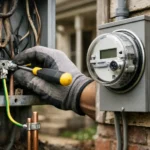
This takes several months of study, and a payment to its of $535 for this card and the test to pass muster. It has been required since march of this year to work on pg&e systems. If your electrician is doing PG&E service work and cannot show the right identification on site, your job can stop fast. PG&E now requires an ITS certification card to be produced during the work, and you can ask to see if the electrician has this card, and all of his workers also have to have this plastic ID card, or PG&E can terminate your power connection from the pole. That is not a small paperwork issue. It can affect your power restoration, your inspection timeline, and your entire panel upgrade project.
Why this PG&E ITS certification card matters
This rule matters most on jobs involving the utility side of the electrical service. That includes overhead service work, underground service work, meter-main replacements, and many 100-amp to 200-amp panel upgrades where PG&E has to disconnect and reconnect power. If the contractor or crew is not properly registered through ITS and carrying the required plastic ID card, PG&E can refuse to proceed or cut the job off.
For a homeowner, landlord, or buyer trying to close a repair quickly, that means delay, added cost, and possible rescheduling with the city inspector and the utility. For a real estate agent or contractor coordinating multiple trades, one missing card can throw off the whole schedule.
Ask to see the card before work starts
Homeowners are allowed to ask. In fact, you should ask if the electrician has the ITS certification card and whether every worker on the job who is involved in that PG&E service work also has the required plastic ID card.
That does not mean every electrician in California needs this for every small repair. If someone is changing a receptacle, replacing a light fixture, or troubleshooting an interior branch circuit, this is a different type of work. But if the job involves PG&E service equipment, disconnects, reconnections, or utility coordination, the ITS credential becomes a real issue.
A qualified contractor should not get offended by the question. They should expect it. This is basic due diligence, the same as asking if they are licensed, bonded, and insured.
What jobs are most affected by PG&E now requiring an ITS certification card during the work?
The biggest problem shows up on service upgrades and panel replacements. That includes replacing old Federal Pacific, Zinsco, fuse panels, damaged meter sockets, and outdated service equipment. These are exactly the jobs where timing matters because the house may be without power until the work passes inspection and PG&E reconnects it.
If your home has an old panel and you are upgrading for safety, adding an EV charger, installing air conditioning, or correcting a failed home inspection item, you do not want surprises on reconnect day. The electrician should already know whether the project requires PG&E coordination, whether overhead or underground rules apply, and whether every person touching that part of the work is properly credentialed.
A license alone may not be enough
This is where many property owners get confused. A contractor can hold a valid C-10 electrical license and still not be the right contractor for PG&E service work if they are not registered properly for that utility-related scope. Licensing matters. Experience matters. But on these jobs, utility compliance matters too.
That is especially true on older East Bay properties where service equipment has been modified over decades. Some homes have patched wiring, mismatched breakers, old mast equipment, or grounding problems that make a simple panel swap turn into a more technical service correction. On those jobs, you want a contractor who handles this type of work routinely, not someone learning the process on your house.
How to protect yourself before the shutoff
Ask a few direct questions before the utility disconnect is scheduled. Is this job considered PG&E service work? Will the electrician on site have a current ITS certification card? Will each worker involved have the required plastic ID card? Who is coordinating the disconnect, inspection, and reconnect? If there is a problem on reconnect day, who is responsible for correcting it?
Those questions tell you a lot. An experienced contractor will answer clearly and without hedging. If the response is vague, that is a warning sign.
Why experienced PG&E panel contractors stand out
Service upgrades are not just about swapping metal boxes and breakers. They involve load calculations, code compliance, grounding and bonding, permit coordination, inspection timing, and utility rules that can change. The best contractors treat the PG&E side of the work with the same seriousness as the wiring inside the building.
That is one reason specialized panel contractors stand out in Oakland, Berkeley, Piedmont, and nearby older-home areas. Many homes there still have obsolete or hazardous equipment, and the utility coordination is often the hardest part of the job. A contractor who already knows the PG&E process, the inspection sequence, and the ITS card requirement can keep the project moving.
Williams Electric is one example of a contractor that is registered with ITS for PG&E system work, including overhead and underground systems. That matters when the job is not a simple interior repair but a full service change that has to be done right the first time.
If you are planning a panel replacement, meter-main upgrade, or 200-amp service upgrade, ask to see credentials before the power is shut off. It is a simple question that can save you a long day without electricity.