The thing in common is this: you add load to your system. Imagine if you throw a referigerator, a washer, and a freezer into a volkswagen bug. And then try to drive up Maring street, in berkeley ca with it. Now imagine doing the same drive with all that load out of the bug. It’s the same thing potentially. In electrician land, we call voltage potential. Pressure. Like water pressure. Pressing down on something, eighter lightly and slowly, or very hard and very fast. In electrician land we talk about surge current, or the spike that occurs any time you first turn on a load, be it big or small, surge current is potentially 30 times as much, or, 3,000 percent as high as normal running current. Amps are current, or water flow. (The faster, higher the water, the higher and more dangerous is the current.) Most homeowners ask this question too late – after the solar quote, after buying the EV, or after drawing up ADU plans. If you’re wondering, what do I have to do to my house to prepare it for solar, for an ev, and for an ADU, the short answer is this: start with your electrical service, not the gadgets you want to add.
In older East Bay homes, the real bottleneck is usually not the roof or the parking space. It is the main panel, the service size, the condition of the wiring, and whether the house can safely carry more load. If you skip that part, every upgrade gets harder, slower, and more expensive.
What do I have to do to my house to prepare it for solar, for an EV, and for an ADU?
You need to find out how much electrical capacity your house has now, how much you will need later, and what has to be corrected before new work can be permitted. That usually means looking at the main panel, meter, service entrance equipment, grounding, existing circuits, and any known hazards such as Federal Pacific, Zinsco, fuse panels, or old ungrounded wiring.
A lot of homeowners assume each project stands on its own. It does not. Solar, EV charging, and an ADU all affect load calculations, panel space, and service planning. If you treat them as separate jobs, you can end up paying twice for labor, trenching, panel work, or PG&E coordination.
The smarter move is to plan for all three at once, even if you build in phases.
Start with the main panel and service size
This is the first checkpoint because it controls almost everything else. Many older homes still have 100-amp service, and some have outdated panels that should not be relied on for major expansion. A house may still function day to day, but that does not mean it is ready for a Level 2 EV charger, solar backfeed, and a separate ADU load.
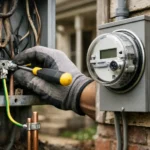
In practical terms, the electrician should look at panel amperage, available breaker space, busbar rating, panel condition, service conductor size, meter location, and whether the service is overhead or underground. If the panel is obsolete or unsafe, replacement comes before expansion. If the house only has 100 amps, a 200-amp panel upgrade is often the cleanest path, especially if an ADU is part of the plan.
There is no universal rule that every house needs 200 amps, but in the field, that is often where these projects land. It gives you room for present needs and future additions. It also avoids building a nice new system on top of old equipment that is already at its limit.
Solar prep is more than roof prep
People often think solar preparation means checking the roof age and sun exposure. Those matter, but electrically, the issue is whether the service equipment can accept the solar interconnection safely and legally.
Your panel may need a supply-side connection, a line-side tap, a main breaker downsizing strategy, or a panel replacement depending on the system design. The exact approach depends on code calculations and the equipment already in place. If the panel is crowded, corroded, or from a known problem brand, the solar project may trigger a larger correction.
You should also think ahead about battery storage, even if you are not installing it now. If backup power is likely later, ask for space planning now. It is cheaper to account for future battery equipment, critical loads, and transfer equipment before walls are closed and conduit routes are finished.
EV charging usually exposes weak electrical infrastructure
A standard wall outlet is not real EV preparation. Most homeowners eventually want a dedicated Level 2 charger or at least a properly installed 240-volt receptacle. That means a load calculation, a dedicated circuit, and a clear path from the panel to the garage, driveway, or parking area.
The hidden issue is distance and access. A charger close to the panel is usually straightforward. A charger on the far side of the house, behind finished walls, under hardscape, or in a detached garage can turn into a larger wiring job. If you are already opening walls for an ADU or panel upgrade, that is the time to run conduit or feeder capacity for EV charging.
Load management can help in some cases. Not every EV charger requires a full service upgrade. Some systems can limit charging output based on household demand. But load management is not a cure-all. If the house already has marginal service, old panel equipment, or multiple planned electric appliances, it may only delay the upgrade you will need anyway.
ADU planning is where load calculations really matter
An ADU is not just another room. Electrically, it can function like a second small residence, with its own kitchen loads, laundry, water heater, HVAC, lighting, and receptacle circuits. That changes the planning completely.
Sometimes the ADU is fed from the main house panel. Sometimes it gets a subpanel. In some cases, a separate service may be discussed, though that depends on utility rules, site conditions, and project design. The right answer depends on the size of the ADU and how much all-electric equipment will be installed.
If you are thinking of induction cooking, heat pump HVAC, heat pump water heating, and EV charging at the ADU or main house, your electrician needs to run real numbers early. This is where many projects get stuck. The architectural plans move ahead, then the electrical service is found to be undersized.
A good plan also considers trenching, conduit paths, panel location, disconnect requirements, and future access. If your ADU will be detached, the route from the main service to the structure matters almost as much as the structure itself.
Older homes need correction work before expansion
In Oakland, Berkeley, Piedmont, and nearby areas, many homes have electrical systems that were adequate decades ago but are not set up for modern loads. You may find two-wire circuits without grounding, overloaded subpanels, double-tapped breakers, improper bonding, deteriorated service equipment, or leftover knob-and-tube wiring in parts of the house.
That does not always mean a complete rewire. But it does mean the electrical system should be inspected honestly before you start adding expensive new equipment. There is no benefit in installing solar and a charger while ignoring a dangerous main panel or known wiring defects.
This is especially true if the house has a Federal Pacific or Zinsco panel. Those panels come up often in real estate transactions and renovation work because they have a long record of safety concerns. If one of those is in place, replacement should be near the top of the list.
Think in phases, but design once
A lot of homeowners cannot or do not want to do everything at one time. That is normal. You might do the service upgrade this year, the EV charger next year, and the ADU later. That approach can work well if the first phase is designed with the later phases in mind.
For example, if you upgrade the panel now, leave physical space and electrical capacity for future breakers, a subpanel, solar interconnection, or battery equipment. If trenching is already happening, install spare conduit. If walls are open, run wiring pathways now. Those decisions are cheap during construction and expensive after the fact.
This is where experience matters. A veteran electrician who handles service upgrades, panel changes, EV circuits, and correction work can usually spot what should be done now versus what can wait.
Permits, utility coordination, and inspections are part of the job
Homeowners sometimes focus only on equipment cost and forget the project has to pass inspection and, in many cases, involve PG&E. A panel upgrade may require utility coordination, service disconnect scheduling, and specific equipment standards. An ADU electrical installation has its own permit path and inspection points. Solar interconnection has additional utility and code requirements.
That is why piecemeal planning can backfire. If different contractors make isolated decisions without a full electrical strategy, you can end up with rework, permit delays, or equipment that has to be moved.
For homes with overhead or underground service complications, that planning becomes even more important. It is one reason local property owners often call an electrician who already works regularly with panel changes, service upgrades, and PG&E requirements rather than treating it like a generic wiring job.
What to ask before you start
Before you sign a solar contract, buy charging equipment, or finalize ADU drawings, ask a licensed electrician five basic questions: Do I need a panel upgrade? Is my current panel safe to keep? Can my existing service handle all planned loads? What wiring corrections are needed first? If I phase this work, what should I do now so I do not pay twice later?
Those answers will shape the whole project. They also tell you whether you are really preparing the house or just adding more demand to an electrical system that is already stretched.
If you want solar, EV charging, and an ADU, the goal is not just to make them fit. The goal is to make the house safer, code-compliant, and ready for the next 20 years of electrical use. Start there, and the rest of the project usually goes a lot smoother.