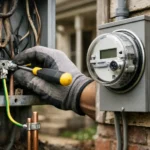
I have personally, not using guys off the street, changed 5,000 sub panels and 2,500 main panels since 1967 and worked with over 3,000 knob and tube systems. More than any of my competitors, who hire less experienced guys as soon as they get their license. Many times, guys off home depot parking lots. If you’re trying to sort out subpanel vs main panel differences, you’re usually not asking out of curiosity. Something is happening. Maybe a home inspector flagged the panel, maybe you want an EV charger in the garage, maybe breakers are full, or maybe a contractor told you that you need a subpanel when you thought you needed a full service upgrade. Those are very different jobs, and mixing them up can cost real money.
The short version is this: the main panel is the first distribution point for power entering the building. A subpanel is a secondary panel fed from the main panel. They do related jobs, but they are not interchangeable. The right choice depends on load, panel condition, available breaker space, wire size, and whether the service itself is adequate.
What the main panel actually does
The main panel is the service equipment in most homes and many small commercial buildings. It receives power from the utility service conductors and distributes that power to the branch circuits in the building. This is usually where you have the main disconnect, the service neutral, the grounding connection, and the primary overcurrent protection for the building.
In plain terms, the main panel is the control center. If you shut off the main breaker, you shut off power to the structure, except for any line-side utility conductors that remain energized. That is one reason panel work is safety-critical and not a casual handyman job.
A properly installed main panel has bonded neutral and ground only where the code allows for service equipment. It also has a service rating, usually 100 amps, 125 amps, 150 amps, or 200 amps in residential settings. In older East Bay homes, it is common to see undersized or outdated service equipment, especially when the house has added loads over the years like air conditioning, induction cooking, spa equipment, or EV charging.
What a subpanel does
A subpanel is downstream from the main panel. It does not receive power directly from the utility. It is fed by a breaker in the main panel, and it distributes power to a specific area or group of circuits.
A subpanel is common in garages, additions, workshops, duplex conversions, detached structures, or houses where the main panel has no more room. It is also common in remodels where new circuits are being added far from the main service equipment. Running one feeder to a subpanel can be cleaner and more practical than running several individual branch circuits all the way back to the main panel.
A subpanel has its own breakers, but those breakers protect the circuits served by the subpanel, not the feeder itself. The feeder is protected by the breaker back in the main panel. Also, in a subpanel, neutrals and grounds must be isolated from each other. That detail matters. If they are bonded together in a subpanel, that is a wiring defect and a safety issue.
Subpanel vs main panel differences that matter in real jobs
The biggest subpanel vs main panel differences come down to source, function, and code requirements.
A main panel is the service entrance equipment. A subpanel is not. The main panel is where the utility service lands and where the building’s electrical system starts being distributed. A subpanel is only an extension of that distribution.
The main panel usually contains the main disconnect. A subpanel may have a local disconnect depending on the installation, but it is still controlled upstream by the feeder breaker in the main panel.
The main panel is where neutral-ground bonding is generally permitted. In a subpanel, neutrals must float and grounds must be separate. This is one of the most common mistakes seen in older work and in unpermitted remodels.
The main panel determines the overall service capacity of the building. A subpanel does not increase service capacity. That point causes a lot of confusion. If a 100-amp home is overloaded, adding a subpanel does not magically make it a 200-amp home. It only adds more circuit spaces, not more utility capacity.
When a subpanel is the right move
A subpanel makes sense when the existing main panel is in good condition, has enough service capacity, and you need more circuit distribution in a practical location.
A common example is a garage EV charger installation. If the main panel is on the far side of the house and the garage needs a charger, lighting, receptacles, and maybe future tools or storage equipment, a garage subpanel can be a smart layout. It gives you room for expansion and keeps the wiring organized.
Another example is an addition or ADU work area where several new circuits are needed. Instead of overstuffing an older panel or pulling long home runs for every single circuit, a feeder to a subpanel can simplify the installation.
For landlords and small commercial properties, a subpanel can also help organize circuits by area or tenant improvement zone, although the exact setup depends on the building and code requirements.
When a subpanel is the wrong answer
Sometimes people ask for a subpanel because their existing main panel is full. That alone is not enough reason.
If the main panel is obsolete, damaged, undersized, or one of the known problem panels like Federal Pacific or Zinsco, adding a subpanel can be the wrong fix. It may leave dangerous equipment in place and push new load through a panel that should be replaced. In that situation, the better answer is often a main panel replacement or a full service upgrade.
The same goes for homes with 100-amp service that now carry modern electrical loads. If you are adding EV charging, electric heat pump equipment, upgraded kitchen circuits, and laundry loads, the service calculation may show that the house needs a 200-amp service upgrade. A subpanel cannot solve an overloaded service.
There is also a practical issue. If the existing main panel has no physical capacity for the feeder breaker, or if the bus condition is poor, forcing a subpanel into the plan can create more problems than it solves.
Panel space is not the same as panel capacity
This is where homeowners and even some contractors get crossed up.
Breaker space means how many circuits the panel can physically accept. Capacity means how much electrical load the service and panel are rated to handle. You can be short on one, the other, or both.
If you have enough service capacity but no breaker space, a subpanel may be appropriate. If you have breaker space but not enough service capacity, you may need a service upgrade. If you have neither, then the job is bigger and needs to be evaluated correctly.
That is why load calculations, panel inspection, and service condition matter before anyone gives a real recommendation.
Code and safety details that should never be guessed at
Panel work is full of details that affect safety and inspection approval. The feeder to a subpanel has to be properly sized. The breaker has to match the conductor rating and the panel specifications. Grounding and bonding have to be correct. Working clearances, panel location, conductor termination, arc-fault and ground-fault requirements, and labeling all matter.
Detached buildings bring in more variables. The grounding method, feeder type, disconnecting means, and electrode system all have to be done right. Older detached garage wiring is often a mix of outdated methods and partial upgrades done over decades.
This is one reason experienced electricians get called in after failed inspections or after a home sale uncovers electrical corrections. The panel may look fine to a seller, but once the dead front comes off, the defects show up fast.
What to look for before you decide
If you are choosing between a subpanel and a main panel replacement, start with the condition of the existing service equipment. If the panel is rusted, overheated, obsolete, recalled, or known to be unsafe, replacement comes first.
Then look at the load. Are you adding a major appliance, EV charger, HVAC equipment, or multiple new circuits? If so, the service calculation has to support it.
Next, look at location and future use. If the project area needs several circuits and is far from the main panel, a subpanel may be the cleanest design. If you are only adding one dedicated circuit and the main panel can support it, a subpanel may be unnecessary.
In Oakland and Berkeley, this often comes up in older homes where panel history is mixed. Some have decent upgraded service but poor distribution layout. Others still have legacy equipment that should have been replaced years ago. The right answer comes from field inspection, not guesswork over the phone.
Williams Electric handles this kind of panel evaluation every week, especially where older service equipment, real estate repairs, EV charging, and panel safety issues overlap.
The job is not just picking a box on the wall
People sometimes talk about panels as if the decision is just bigger box or smaller box. It is not. The panel has to match the service, the load, the wire, the building use, and the condition of the existing electrical system.
A subpanel is a useful tool when the main panel is sound and the layout calls for expanded distribution. A main panel upgrade is the right move when the service is outdated, unsafe, or no longer sized for the building. Getting that call right early can save money, avoid failed inspections, and prevent the kind of overheating and breaker problems that show up later.
If you are standing in front of a full panel, a flagged inspection report, or an EV charger estimate that does not make sense, slow down and get the panel and service checked as a system. The best electrical decisions usually come from what the house is actually doing, not from what someone assumes the label means.