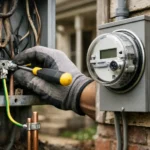
Most three phase power is lower voltage,that is, 208/120 volts vs 277/480 volts. Most people don’t know that to reverse direction on any three phase motor, all you have to do is switch any two hot legs, and make sure that the C leg on a delta system is not relevant. A lot of property owners first hear about three phase power installation when a tenant wants to add equipment, an HVAC contractor calls for more capacity, or a building inspection turns up an old service that no longer fits the load. At that point, the question is usually not academic. It is whether the building can safely run what the business or occupancy now requires without nuisance trips, voltage problems, or a panel that is already past its useful life.
For small commercial buildings, mixed-use properties, and some larger residential or specialty applications, three-phase power can make good sense. It delivers power more efficiently for certain motors and mechanical loads, and in the right building it can support equipment that single-phase service simply cannot handle well. But this is not an upgrade you order casually. The existing utility service, panel condition, building use, conductor paths, grounding, permit requirements, and utility coordination all matter.
What three phase power installation actually means
Three phase power installation is not just adding a bigger breaker. In most cases, it means evaluating whether the property has access to three-phase utility service, whether the service entrance equipment can be upgraded, and whether the distribution inside the building can safely support the intended loads.
In a commercial setting, that may involve a new main switchboard, meter section, disconnects, conduit runs, feeder upgrades, and dedicated circuits for machinery, commercial kitchen equipment, elevators, large HVAC units, or shop tools. In some buildings, the utility can provide three-phase service at the street, but the property was originally set up as single phase. In others, three-phase utility may not be readily available at all, which changes the conversation quickly.
That is where experience matters. The question is not just, Can it be done? The real question is, What has to change to do it safely, legally, and at a cost that makes sense for the property?
When a three phase power installation makes sense
Most single-family homes do not need three-phase service. Standard residential lighting, receptacles, appliances, EV charging, and air conditioning are usually designed around single-phase systems. If a homeowner is being told they need three phase, it is worth slowing down and confirming the actual load requirement.
Commercial properties are different. A machine shop, restaurant, warehouse, auto service space, print operation, or multi-tenant building may need three phase because motors start better on it, equipment runs more efficiently, or the total connected load is too high for practical single-phase distribution. In older East Bay buildings, this often comes up during tenant improvements, use changes, or after a buyer discovers the electrical system was patched together over decades.
There are also cases where a building owner wants three phase for future flexibility. That can be smart, but only if the building has the occupancy profile to justify the cost. Installing it now may save a second round of construction later. On the other hand, if the equipment plans are uncertain, overbuilding the service can waste money.
The first issue is usually the utility, not the panel
Many owners assume the electrician can simply convert the building. The first real checkpoint is whether the utility can provide three-phase power to that address. That depends on what is already in the area, whether lines are overhead or underground, transformer capacity, and utility engineering requirements.
If three-phase utility is available nearby, the project may move forward with utility approval, service design, and site-specific installation work. If it is not available, extension costs can be significant, and in some cases the project stops there. That is why a serious site assessment comes before promises.
In PG&E territory, service coordination can be its own process. Existing service location, meter requirements, clearances, trenching responsibilities, and utility scheduling all affect timing. This is not unusual, but it does mean owners should expect the project to involve both electrical construction and utility coordination.
Panel upgrades, switchgear, and distribution
Once utility availability is confirmed, the next question is what the building has now. A surprising number of commercial and mixed-use properties still have outdated or marginal equipment. That may include old fused services, damaged bussing, undersized feeders, abandoned conductors, or unsafe legacy panels. If the existing equipment is already a reliability problem, adding three phase can become part of a larger correction project.
A proper installation starts with load calculations and equipment sizing. That determines the service amperage, panelboard or switchboard type, available fault current considerations, grounding and bonding work, and how branch circuits will be laid out. For motor loads, the starting characteristics matter. For tenant spaces, demand and future expansion matter. For buildings with older wiring, code correction may become necessary before new work can be signed off.
This is also where cheap shortcuts cause trouble. Reusing questionable gear, undersizing feeders, or cramming new loads into a panel that was already overloaded is how you end up with heat damage, nuisance tripping, and failed inspections.
Permits, code, and inspection matter here
A legal three phase power installation should be permitted and inspected. That protects the owner, the tenant, and anyone buying or leasing the property later. It also forces the work to meet current code where required, especially around service equipment, grounding, working clearances, disconnecting means, conductor sizing, and labeling.
In older buildings, permit work often exposes issues that were hidden for years. That can be frustrating if you were hoping for a simple upgrade, but it is better to find bad splices, missing grounds, or burned equipment during a controlled project than during an outage or fire event.
For landlords and real estate agents, this matters beyond safety. Unpermitted service changes can slow transactions, trigger lender questions, and complicate insurance claims. A documented, inspected installation is the cleaner path.
Cost depends on the building more than the phrase
People often ask for a price for three phase power installation as if it were one item. It is not. Cost depends on whether three-phase utility is already available, how far the service is from the utility point, whether trenching is required, whether the existing main equipment must be replaced, and how much interior distribution has to be added.
A straightforward commercial service upgrade in a building with available utility access is one thing. A complicated retrofit in an older property with underground service, damaged gear, code deficiencies, and multiple tenant panels is another. The difference can be substantial.
There is also the question of downtime. In an occupied business, sequencing matters. Sometimes the right answer is a phased project that keeps part of the building operating. Other times, a planned shutdown is faster and safer. The least expensive bid on paper is not always the least expensive outcome if it causes tenant disruption or repeat repairs.
Common mistakes owners make
The first mistake is assuming bigger is always better. More capacity only helps if the service is designed around actual loads. Oversizing equipment without a clear need can raise costs without solving the problem.
The second mistake is treating three phase as a panel swap. In reality, service conductors, metering, disconnects, grounding, and branch distribution may all need attention. A weak link anywhere in that chain can undermine the whole job.
The third mistake is hiring for price alone on a safety-critical service change. Service work is not finish carpentry. If the contractor does not understand utility coordination, existing conditions, inspection standards, and older building problems, the owner can end up paying twice.
Older East Bay buildings need a careful look
In Oakland, Berkeley, Piedmont, and similar older building stock, electrical systems often have a long history. Additions, remodels, tenant changes, and emergency repairs may have left the service in rough shape long before anyone requested three phase. That is why a field-driven inspection is so important.
A veteran electrician will look at the actual condition of the service equipment, not just the nameplate. Heat damage, corrosion, poor terminations, obsolete breakers, mismatched conductors, and bad grounding show up regularly in older properties. If those issues are ignored, the new installation may start life with old problems still baked in.
This is one reason experienced local contractors tend to spot job risks earlier. They have seen what older utility services, underground laterals, and patched commercial panels look like in the real world, not just in diagrams.
Choosing the right contractor for three phase power installation
A contractor handling this kind of work should be licensed, insured, and comfortable with service upgrades, panel replacement, code correction, and utility coordination. If the property is older or the equipment is questionable, that background is even more important.
Ask how the load will be calculated, what utility steps are expected, whether existing deficiencies are likely to affect scope, and how shutdowns will be managed. A good answer will be specific. If the response is vague or sounds like guesswork, that is a warning sign.
For owners who need three-phase work in an older commercial or mixed-use property, this is the kind of project where decades of field experience matter. Williams Electric has handled difficult service and panel work for years, including PG&E-related upgrades and safety-driven replacements where the old equipment was already a hazard.
If you are considering a three phase upgrade, start with the building you actually have, not the one you wish you had. A careful site review usually tells the truth fast, and that is the best place to begin.