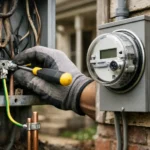
What should I do if my lights start flickering? A flickering light is not just annoying. In many homes and small commercial buildings, it is the first visible sign of a loose connection, overloaded circuit, failing breaker, bad neutral, a missing hot strand: (There are two hot wires, (strands we call them) in any 240 volt home system. If one strand is loose, and going bad, it will affect every other breaker spot, on the bus bar, that is, every other breaker will be affected, and therefore, more than one circuit will be affected, causing flickering in many areas, not just one room. (Old houses sometimes only have 120 volts, or just one hot strand, wire, or an aging electrical panel. If you are asking, What do I need to do if my lights start flickering, or have been flickering?, the right answer depends on where the flicker is happening, what else is affected, and whether the problem is getting worse. Bad pole connection, bad weather head connection, bad meter, or meter lug, or bad main breaker, or bad sub panel breaker, each can cause flickering. Call PG&E and demand a “beast test”, as they place a meter on your meter base, and draw 22 amps from their part of your system, that is, up to the weather head, and on to the pole connection.
Some flickering is minor and isolated. Some is a fire hazard. The key is knowing the difference and not guessing.
What do I need to do if my lights start flickering, or have been flickering?
Start with the simplest check. If only one light flickers, turn the switch off and let the bulb cool. Then make sure the bulb is the correct type and is screwed in properly. A loose bulb, a failing LED lamp, or an incompatible dimmer can cause flickering without there being a larger wiring problem.
If the same fixture keeps flickering after a new bulb is installed, the problem may be in the socket, the switch, the fixture wiring, or the branch circuit. At that point, stop treating it like a bulb problem.
If multiple lights flicker, especially in different rooms, the issue is more serious. Watch for patterns. Do the lights dim when the microwave, air conditioner, or vacuum turns on? Do they brighten and dim randomly? Is it only on one circuit, or across the whole house? Those details matter because they help narrow the issue down to an overloaded circuit, a loose connection, a panel problem, or a utility-side issue.
When flickering lights are a warning sign
Flickering becomes a safety issue when it comes with other symptoms. If you notice a burning smell, buzzing from a panel or switch, warm outlets, breakers tripping, sparks, partial power loss, or lights getting unusually bright, treat it as urgent. Those are not normal electrical quirks.
One of the most concerning signs is lights that get brighter in one area while dimming in another. That can point to a loose or failing neutral connection. A bad neutral can damage appliances and electronics because voltage may become unstable. This is not a wait-and-see problem.
Another red flag is flickering tied to an older service panel. Homes with Federal Pacific, Zinsco, fuse panels, or other outdated equipment often have hidden failure points that do not show up until there is visible trouble. In older East Bay homes, flickering may be part of a bigger problem involving panel deterioration, poor terminations, grounding issues, or old wiring methods.
Common causes of flickering lights
There is no single cause, which is why quick online answers can be misleading. In the field, the most common causes include loose light bulbs, failing lamps, bad dimmer switches, poor fixture connections, loose wire splices, overloaded circuits, worn breakers, damaged conductors, bad neutrals, panel defects, and utility service problems.
LED lighting adds another layer. LEDs often flicker when paired with older dimmers that were designed for incandescent bulbs. That does not usually mean the house wiring is dangerous, but it still needs correction. The fix may be as simple as replacing the dimmer with one rated for the specific LED load.
On the other hand, if lights flicker whenever a large appliance starts, the issue may be circuit loading or voltage drop. That might be normal within limits, but heavy dimming or widespread flicker suggests the circuit design, wire size, breaker condition, or panel capacity should be checked.
In commercial spaces, flickering may come from failing ballasts, driver issues in LED fixtures, shared neutral problems, or circuit imbalances. The right diagnosis depends on the building type and how the circuits were installed.
What you can check safely before calling an electrician
There are a few things a property owner can observe without taking anything apart. First, identify whether the flickering is in one fixture, one room, or throughout the building. Second, notice whether it happens all the time or only when certain equipment turns on. Third, check whether any breaker has tripped or feels loose when reset. Fourth, ask whether the building has an older panel or a history of electrical repairs, failed inspections, or recurring breaker issues.
You can also test whether the problem follows the bulb. Move a known good bulb into the fixture. If the flicker stays with the fixture, the lamp was not the issue. If a dimmer is involved, try setting it to full brightness. Some dimmer-related flicker shows up only at lower settings.
What you should not do is remove panel covers, tighten live terminations, replace breakers blindly, or open devices if you are not qualified. A loose connection behind a switch or inside a panel may already be arcing. That is how a small flicker complaint turns into burned wiring.
When to turn power off and stop using the circuit
If the flickering is paired with heat, odor, crackling, visible damage, or repeated breaker trips, stop using that circuit. Turn the affected switch off. If you can identify the correct breaker safely, turn it off as well. Do not keep resetting a breaker that trips again. Breakers trip for a reason.
If the main panel is making noise, smells burned, shows scorching, or has obvious signs of water intrusion or corrosion, that is a different level of risk. Shut power down if it is safe to do so and call a licensed electrician. The same applies if half the house loses power, lights become very bright, or 120-volt appliances start acting erratically. Those are classic signs of a neutral issue that can damage equipment quickly.
How an electrician diagnoses flickering lights
A proper diagnosis is not guesswork. A licensed electrician will usually start by asking when the flickering happens, what equipment is running, whether it is isolated or widespread, and what kind of panel and wiring the building has. Then the electrician tests voltage, checks load behavior, inspects terminations, evaluates breakers, and looks for heat damage, corrosion, and code issues.
If the problem is at a fixture or switch, the repair may be straightforward. If the problem is in the panel, service mast, meter section, grounding, or utility connection, the repair becomes more specialized. In some cases, the electrician may confirm that the problem is on the PG&E side and document what was found so the utility can address it.
That distinction matters. Not every flickering issue is inside the home, but you need someone who can tell the difference confidently.
Older homes and older panels need extra caution
Many homes in Oakland, Berkeley, Piedmont, and nearby areas still have aging electrical infrastructure. That means older panels, mixed wiring, ungrounded circuits, handyman repairs, and additions that were never properly balanced or upgraded. In those buildings, flickering lights are often a symptom, not the whole problem.
A worn-out panel may still appear to work while hiding bad breaker contact, overheating bus bars, or unsafe legacy equipment. Federal Pacific and Zinsco panels are especially known for trouble. If flickering is happening in a home with one of these panels, the conversation should include whether the panel itself is part of the failure. Repairing a light fixture while ignoring a failing panel is not a real fix.
This is also common during home sales and inspection work. Buyers, landlords, and real estate agents often hear about flickering lights along with other findings like double taps, missing bonding, damaged breakers, improper grounding, or overloaded subpanels. Those issues tend to travel together.
When a simple repair is enough and when an upgrade makes more sense
Sometimes the fix is exactly what people hope for: a bad bulb, a loose socket, a failed switch, or a dimmer mismatch. Those are routine service calls.
But if the flickering traces back to repeated overloads, deteriorated breakers, obsolete panels, undersized service, or unsafe wiring, patching one symptom is not cost-effective. In that case, a panel repair, breaker replacement, dedicated circuit, service upgrade, or wiring correction may be the right move. It costs more upfront, but it addresses the real failure point and reduces the chance of future outages or fire risk.
For homes adding EV charging, air conditioning, induction cooking, or heavier appliance loads, existing electrical systems are often already at their limit. Flickering lights can be the early warning that the service is undersized or the panel is failing under load.
The practical next step
If one bulb flickers once, replace it and monitor it. If one fixture keeps flickering, have the fixture, switch, and circuit checked. If multiple lights flicker, or the flicker comes with buzzing, burning smell, breaker problems, brightening and dimming, or an older panel, do not ignore it.
Electrical problems usually do not repair themselves. They either stay hidden or get worse. A careful inspection now is usually cheaper than waiting for a burned breaker, damaged appliance, or emergency outage later.