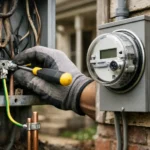
If multiple circuits in the house are flickering, or causing dead power, then it’s either or bad hot line or a bad neutral line. The first step is to call PG&E 800 743-5000 and ask for a beast test, that is,they put a draw/meter in your meter jaw, and draw 22 amps through their part of your system, the meter base, the lugs, the weather head, the pole connection, which eliminates the possibility that it’s on your end. Tell them it’s a loose hot strand or neutral and they will come running! (Don’t want the liability/claims made on burned up appliances.) When the entire house goes dark but the neighbor’s lights are still on, you are not dealing with a simple tripped branch breaker. Whole house power outage troubleshooting starts at the service, not at the lamps, outlets, or appliances. The goal is to figure out whether the problem is utility-side, panel-side, or a dangerous failure in the main electrical equipment.
A full-house outage can come from a blown utility fuse, a failed main breaker, a burned bus bar, loose service conductors, water damage in the panel, or an old panel that has finally quit under load. In older East Bay homes, especially ones with legacy equipment, the cause is often more serious than homeowners expect. That is why the first step is not guessing. It is checking a few things in the right order and stopping before you put yourself in front of energized equipment.
Start whole house power outage troubleshooting safely
If the entire property is out, first decide whether this is only your building or part of a wider utility outage. Look outside. Check nearby homes, streetlights, and any visible service activity on the block. If several homes are dark, it may be a PG&E issue and not an internal electrical failure.
If your neighbors have power, go to the main panel and look before touching anything. You are checking for signs of heat, burning, buzzing, melted plastic, scorch marks, or moisture. If you smell burning insulation or see discoloration around the main breaker, meter area, or service conductors, stop there. Do not reset anything. A bad main, damaged bus, or failing panel can arc under load, and that is a job for a licensed electrician.
If the panel looks normal from the outside, open the door and check the breaker positions. A main breaker that sits halfway between on and off may have tripped. Some older breakers do not make that obvious. Resetting means turning it fully off first, then back on. If it trips again immediately, leave it off. That points to a real fault, not a nuisance trip.
What a whole house outage usually means
A whole-house outage narrows the list. If one room is dead, that is a branch circuit issue. If the whole panel is dead, the problem is usually at the service disconnect, main breaker, meter socket, service mast, underground lateral, or utility transformer connection.
In the field, a few causes show up again and again. One is a failed main breaker. Main breakers wear out, especially in older panels that have seen decades of load changes, heat cycles, and poor maintenance. Another is a burned stab or bus connection inside the panel. This is common in certain obsolete or unsafe panel brands, including Federal Pacific and Zinsco equipment, where breakers may appear set but not make reliable contact.
Loose service lugs are another serious possibility. Aluminum conductors, corrosion, heat, and past improper work can all create resistance at the main connection points. That resistance builds heat. Heat damages insulation and terminals. Eventually the service opens up and the house goes dark.
Then there is the utility side. A bad overhead connection, damaged service drop, failed underground feed, meter problem, or transformer issue can shut down the whole house without any problem inside your branch circuits. In some cases you may have partial service loss instead, where 120-volt loads act strangely, lights dim unevenly, or some circuits work while others do not. That often points to a lost leg in the service and needs immediate attention.
Check for partial power before you assume total failure
This part matters because partial service loss can damage appliances. During whole house power outage troubleshooting, check whether any 120-volt items still work. Maybe a few lights are dim, the microwave clock is off, but one side of the house still has power. Maybe the electric range, dryer, or HVAC stopped completely.
That pattern can indicate one hot leg is gone while the other remains. In a standard residential 120/240-volt service, losing one leg creates unstable conditions. Some circuits go dead. Others backfeed through shared loads and behave unpredictably. That is not a wait-and-see situation. Turn off large 240-volt loads if you can do so safely, and call for service.
You should also pay attention to any recent warning signs. Flickering lights when the oven turns on, breakers that felt hot, buzzing at the panel, intermittent outages, or a main breaker that needed repeated resetting are all clues. Electrical systems usually give some notice before complete failure.
When the panel itself is the problem
A lot of outage calls trace back to old or damaged panels. Houses built decades ago often still have equipment that was marginal even when it was new. If the home has Federal Pacific, Zinsco, fuse panels, split-bus arrangements, or signs of amateur additions, a full-house outage may be the symptom that finally forces the issue.
This is where experience matters. A panel can fail in ways that are not obvious to a homeowner. The breaker handle may look fine while the internal mechanism is burned. The bus may be damaged behind the breaker. Water intrusion from a poorly sealed mast or meter can create corrosion that interrupts power and raises shock risk at the same time.
In some cases, a reset gets the power back for the moment. That does not mean the system is safe. If a main breaker or bus connection has overheated once, the underlying damage is often still there. Restoring power without repair can leave you with a worse failure later, sometimes at the worst possible time.
What not to do during a full-house outage
Do not remove the panel dead front. Do not pull the meter. Do not tighten lugs or probe live parts. Those are not homeowner troubleshooting steps. The incoming line side can remain energized even when the house is dark, and mistakes there can be fatal.
Do not keep resetting a main breaker that trips repeatedly. Breakers trip for a reason. Repeated resets can increase heat damage and make the eventual repair more expensive.
Do not assume it is safe just because there are no sparks. Electrical failures are often quiet. Heat at a loose connection can build for a long time before visible arcing starts.
Portable generators are another area where people get into trouble. Backfeeding a panel through a dryer outlet or makeshift cord is dangerous, illegal, and can injure utility workers. If backup power is needed, it should be installed with proper transfer equipment.
When to call the utility and when to call an electrician
If the whole neighborhood is out, call the utility first. If your home alone is affected, but there is no sign of burning, the utility may still need to confirm whether power is reaching the meter. They handle utility conductors, transformers, and service issues on their side of the system.
If the utility says power is available at the service point but your house is still dark, the problem is likely in your panel, meter socket, service equipment, or main disconnect. That is electrician territory.
There are also jobs where both parties are involved. A damaged panel riser, meter enclosure, weather head, underground service, or main upgrade often requires coordination. That is common in older homes where the outage uncovers larger code and equipment problems.
For homeowners in older neighborhoods around Oakland, Berkeley, Piedmont, and Lafayette, the age of the electrical system should shape your expectations. If the service equipment is outdated, undersized, or already showing heat damage, repair may not be the best long-term answer. Sometimes the right move is a panel replacement or service upgrade instead of another patch.
What a professional will usually inspect
A qualified electrician approaching whole house power outage troubleshooting will start by verifying where voltage is lost. That means checking the service, meter side conditions, main disconnect, panel bus, and feeder integrity in a controlled and safe way. The point is to locate the failure, not guess from symptoms.
From there, the fix depends on what failed. It may be a main breaker replacement, panel repair, service conductor repair, meter socket replacement, grounding correction, or a full panel change. If the outage exposed dangerous legacy equipment, the safest repair may be to replace the system rather than restore a compromised panel.
This is the kind of work where field experience counts. Geoff Williams has handled service failures, PG&E coordination, panel changes, and older hazardous equipment for decades, including Federal Pacific and Zinsco systems that many electricians would rather avoid. When a whole-house outage is tied to panel damage or service failure, you want someone who knows what they are looking at the first time.
A house that suddenly loses all power is not just inconvenient. It is often your electrical system telling you something important. The smart move is to check the basics, avoid risky DIY work, and treat any service or panel problem as a safety issue, not just a nuisance to get past until tomorrow.