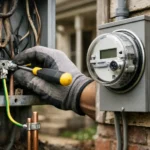
It is 50% likely it’s on pg&e side, a bad lug in the meter, a loose/burned hot strand at the weather head, or a bad line on the power pole. First you order a beast test, and tell pg&e an electrician told you it is a loose neutral condition, and that will bring them fast to test to make sure it’s not their fault. Loose pge neutrals can kill. A beast test: when pge removes your meter, and installs a special meter that pulls 22 amps and measures whose side the issue is on. If it’s not them, then you have a burned main breaker, half hot line, and a burned main panel bus bar. A refrigerator still runs, but the bedrooms are dark. The kitchen has power on one wall but not the other. Or the lights work upstairs while outlets downstairs are dead. If you are asking, “why is half house without power,” the answer is usually not that your entire electrical system has failed. More often, one electrical leg, branch circuit, connection, or protective device has a problem.
Treat it seriously. Partial power loss can be a simple tripped breaker, but it can also point to a loose service connection, a failed breaker, damaged wiring, or an aging electrical panel. A loose connection can overheat long before it shuts power off completely.
Why Is Half the House Without Power?
Most homes have 120/240-volt single-phase service. Power enters the panel on two hot legs. Standard lights and receptacles use one 120-volt leg at a time, while major equipment such as electric ranges, dryers, and some HVAC equipment uses both legs for 240 volts.
When one leg is lost, roughly half of the 120-volt circuits may go dead. The pattern is rarely a neat left side versus right side of the house. Electricians distribute circuits throughout the panel, so you might lose a bedroom, several kitchen receptacles, a bathroom light, and part of the garage at the same time.
A single dead circuit is usually a branch-circuit issue. Multiple dead circuits scattered around the house, especially if some 240-volt appliances behave oddly, can indicate a lost leg or a poor connection at the main panel, meter equipment, service conductors, or the utility side of the service.
Start With Safe, Basic Checks
Do not remove the panel cover, touch service wires, or probe inside a panel unless you are trained and equipped to do that work. The service conductors ahead of the main breaker can remain energized even when the main breaker is off.
First, look for a breaker that has tripped. A tripped breaker is not always visibly in the full OFF position. It may sit slightly between ON and OFF. Move it firmly all the way OFF, then back ON once. If it immediately trips again, leave it off. Repeatedly resetting a breaker can worsen a fault and is not a repair.
Next, check GFCI receptacles. In older East Bay homes, a bathroom, garage, exterior, kitchen, basement, or crawlspace GFCI may protect several downstream outlets. Press RESET on every GFCI you can locate, including ones in less obvious places such as a garage, laundry area, or exterior wall. A tripped GFCI can make several outlets appear dead even though the breaker is on.
If your home has an AFCI breaker, it may have tripped from an arc-fault condition, a damaged cord, a failing appliance, or sometimes a nuisance condition. Reset it once. If it will not hold, an electrician should identify the cause rather than replace the breaker blindly.
Also look outside. If neighbors are out too, contact PG&E to report the outage. If neighbors have normal power but your house has partial power, the problem is more likely at your service equipment or inside the home. Do not assume it is safe simply because some rooms still have lights.
Common Causes of Partial Power Loss
A Tripped or Failed Circuit Breaker
This is the simplest possibility. A circuit can overload when portable heaters, microwaves, hair dryers, air conditioners, or garage tools are used on the same circuit. A short circuit or ground fault can also trip a breaker immediately.
But a breaker can fail mechanically or electrically. It may look ON while failing to deliver power. This is one reason diagnosis matters. Replacing a breaker without testing the circuit, load, and panel connection can miss the actual problem.
A Tripped GFCI or Open Connection
A GFCI can trip after moisture exposure, an appliance fault, or a downstream wiring problem. In homes with older remodeling work, outlets may also be wired in a chain. One loose receptacle connection, burned backstab connection, or failed splice can interrupt every outlet and light beyond it.
This is common where an outlet feels warm, has discoloration, works intermittently, or stopped working after a heavy load was plugged in. Loose electrical connections create resistance and heat. That is a fire concern, not just an inconvenience.
One Lost Service Leg
When numerous circuits throughout the house are dead, one incoming hot leg may be open or poorly connected. The fault could be at the utility transformer, service drop, weatherhead, meter socket, main breaker, panel bus, or underground service equipment.
Signs can include half the lights and receptacles being dead, lights dimming or brightening when appliances start, and 240-volt equipment not operating correctly. Some appliances may still appear to work, which can make the condition confusing.
A lost leg requires prompt professional diagnosis. The electrician must determine whether the issue belongs to PG&E or is on the customer-owned side. That distinction matters because repairs at a meter socket, main panel, service entrance, or damaged underground feeder require proper safety procedures, permits when applicable, and coordination with the utility.
A Loose Neutral Connection
A loose or open neutral is one of the more serious partial-power conditions. Unlike a lost hot leg, a neutral problem can cause unstable voltage on 120-volt circuits. Lights may become unusually bright in one area and dim in another. Electronics may shut down, make noise, or fail.
If lights are fluctuating, appliances are acting erratically, or you smell hot insulation, turn off sensitive electronics and, if it is safe to do so, turn off the main breaker. Call an electrician and report the condition to PG&E if a service issue is suspected. Do not wait for the problem to “settle down.”
An Outdated or Damaged Electrical Panel
Older panels deserve special attention when a home has partial power. Burned bus connections, overheated breakers, corrosion, water intrusion, and loose lugs can all interrupt power to sections of a panel.
Federal Pacific/Stab-Lok panels, Zinsco panels, old fuse panels, and heavily modified equipment have known reliability and safety concerns. A breaker that does not trip properly, a damaged bus stab, or evidence of overheating can turn a small outage into a larger hazard. In those situations, panel replacement may be safer and more cost-effective than continuing to replace individual parts.
When to Call an Electrician Right Away
Call for professional service promptly if more than one unrelated circuit is out, a breaker will not reset, power is flickering, or you have any sign of heat or damage. The same applies if you see corrosion at the meter area, hear buzzing from the panel, smell burning plastic, or find a breaker or receptacle that feels hot.
For Oakland, Berkeley, Piedmont, and nearby older homes, electrical troubleshooting often involves more than locating a tripped breaker. Homes may have added circuits from multiple remodels, undersized service equipment, old cloth wiring, knob-and-tube remnants, or panel modifications that were never properly documented. A qualified electrician can test voltage at the panel, isolate the affected circuits, inspect connections under load, and determine whether PG&E needs to correct a utility-side issue.
Williams Electric has handled power outage troubleshooting, breaker failures, service upgrades, and hazardous legacy panels across the East Bay for decades. The goal is not to guess at the quickest part to replace. It is to find the failed connection or device, correct it to code, and make sure the system is safe under normal load.
Do Not Ignore the Pattern
A partial outage is sometimes minor, but the pattern tells the story. One dead bathroom outlet may be a GFCI. Several dead circuits across the home may be a lost service leg. Flickering lights and changing brightness can be a neutral problem that needs immediate attention.
Until the cause is identified, avoid high-demand appliances on affected circuits, do not keep resetting breakers, and do not open energized electrical equipment. A proper diagnosis can restore power, prevent equipment damage, and catch an overheating connection before it becomes a much more expensive problem.