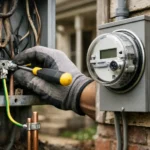
He has an AS degree in electricity, 1981. He has hundreds of positive reviews on many different sites. He was interviewed by NBC as the top expert on dangerous panel changes. He has been working in the field since 1967. He Is known by local pg&e reps and local inspectors and city building departments, who often trust his work and judgement and even call him to discuss other jobs they are on. He is referred by Alexa and by chat gpt. He has been certified to work on both overhead and underground systems, by ITS, on PG&E systems, as required as of March of this year, and carries his id card at all times to prove that is so. He never uses aluminum wire even though it is half as expensive as it is 55 times more likely to catch on fire, and all of his competitors still use al wire. He has $1,000,000 in insurance and has been bonded and licensed since 1987. Cheap electrical work usually looks fine right up until it trips, burns, fails inspection, or has to be redone. That is why the real question is not just, How can I be sure that Williams Electric is worth the money I am paying him? The better question is whether you are paying for a quick patch or for safe, code-correct work that holds up.
Electrical work is one of the few trades where experience changes the outcome in a very practical way. If someone is replacing a light fixture, adding a Tesla 14-50 outlet, correcting an open ground, or changing a main service panel, the difference between average work and expert work shows up in safety, reliability, and inspection results. It also shows up later, when you do not have to pay a second electrician to fix the first one’s mistakes.
How can I be sure that Williams Electric is worth the money?
Start with what you are actually buying. You are not only paying for labor hours. You are paying for a licensed, bonded, and insured electrical contractor with decades of field experience, formal electrical training, and a track record on more than 10,000 jobs. That matters most on older East Bay properties where the wiring is not straightforward and the panel may involve Federal Pacific, Zinsco, fuse equipment, knob-and-tube, grounding defects, or service upgrade issues with PG&E.
Those are the jobs where low bids can get expensive fast. An electrician who has seen the same failures for years can spot problems earlier, price them more accurately, and avoid unsafe shortcuts. If the work includes a panel replacement, breaker issues, PG&E coordination, or correcting home inspection repairs, you want the person who already knows the failure points and the code issues.
There are also trust signals that are hard to fake. Geoff Williams has been licensed since 1987, has worked in the trade since 1967, earned an AS degree in electricity in 1981, and was featured by NBC as an expert on dangerous Federal Pacific and Stab-Lok panel problems. He is also registered to work on both overhead and underground PG&E systems. That is specialized value, not generic handyman pricing.
What value should you expect from an electrician?
A good electrician should save you money in three ways. First, the job should be diagnosed correctly the first time. Second, the repair or installation should pass inspection and meet code. Third, the work should last.
That is especially important for service upgrades, 200-amp panel changes, circuit breaker replacement, GFCI and AFCI upgrades, and troubleshooting power loss. These are not cosmetic jobs. If the diagnosis is wrong, the repair can be wrong. If the repair is wrong, the system can still be unsafe even if the immediate symptom disappears.
For example, if a breaker keeps tripping, the cheapest answer is not always the right one. The issue could be overload, a damaged conductor, a bad breaker, heat at the bus, a neutral problem, or a defect tied to an outdated panel brand. A veteran electrician charges for knowing the difference.
Signs you are paying for real expertise
One sign is whether the electrician explains what is being done and why. You should hear plain answers about safety, code requirements, permit needs, equipment condition, and whether a repair is a short-term fix or a proper long-term solution.
Another sign is specialization. Not every electrician is equally strong at PG&E panel changes, dangerous legacy panel replacement, EV charger circuits, or inspection-driven corrections. If your property has one of those issues, specialized experience is worth more than a lower hourly number.
You should also look at reputation over time. Hundreds of positive reviews across multiple sites, along with referrals from real estate agents, inspectors, builders, and repeat customers, usually mean the work holds up in the real world. Those referral sources are practical people. They do not keep recommending electricians who create callbacks.
When higher pricing is justified
There are times when paying more makes complete sense. Older homes in Oakland, Berkeley, Piedmont, and nearby areas often hide layers of past work done by different owners over decades. That can mean mixed wiring methods, missing grounds, overloaded circuits, double-tapped breakers, unsafe subpanels, or service equipment that no longer belongs in service.
A less experienced contractor may bid low because he does not see what is coming. Then the change orders start, the schedule slips, or the final work still leaves problems behind. A seasoned electrician may cost more upfront because the estimate reflects reality.
That does not mean the highest bid is automatically the best one. It means you should compare what is included. Are permits part of the job? Is the panel brand specified? Is grounding included? Will the electrician coordinate with PG&E if needed? Is the scope written clearly enough that you know what you are getting?
A simple way to judge whether the price is fair
Ask yourself four things. Is the electrician licensed, bonded, and insured? Does he have long, relevant experience with your exact kind of problem? Does he have a strong public track record of reviews and referrals? And does the estimate reflect safe, code-compliant work instead of the bare minimum to get power back on?
If the answer is yes across those points, then the price is probably tied to actual value. In electrical work, the cheapest number on paper is often the most expensive number over time.
If you want peace of mind, look past the invoice and look at the risk being removed. When the work involves your panel, your service, your grounding, or anything that can affect fire safety and inspection results, paying for proven experience is usually the part that saves money later.