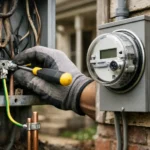
A low quote on a Zinsco panel job can get expensive fast if it leaves out the service mast, grounding, permit corrections, or PG&E coordination. That is why homeowners asking about Sylvania zinsco panel replacement cost need more than a ballpark number. They need to know what the price actually includes, what can push it up, and what corners should never be cut.
What is the typical Zinsco panel replacement cost?
In most older homes, a full Zinsco panel replacement cost lands somewhere between $3,500 and $8,500. That is a real-world range for replacing a dangerous obsolete panel with a modern code-compliant main panel. Some jobs come in lower if the existing service is straightforward and the replacement is like-for-like. Others go higher when the service equipment, grounding, meter section, or utility side work also needs to be corrected.
If the home still has a 100-amp service and the goal is only to replace the bad panel without increasing capacity, the cost is usually toward the lower end of the range. If the house needs a 200-amp panel upgrade, a new riser, new grounding electrodes, meter work, permit handling, and utility coordination, the number moves up quickly.
That spread is normal. Panel replacement is not one fixed product. It is a safety-critical service job, and the existing conditions matter.
Why Zinsco panels cost more to deal with than newer panels
Zinsco panels are not just old. They are known for breaker and bus bar problems that can create real safety issues. Breakers may fail to trip. Connections can overheat. Damage inside the panel can be worse than what is visible from the outside.
That matters for pricing because electricians often find heat damage, corrosion, loose terminations, or improper modifications once the panel is opened. A house that looks like a simple panel swap on paper may need conductor repair, meter socket replacement, bonding corrections, or replacement of damaged branch breakers and wiring terminations.
This is also why the cheapest estimate is not always the best estimate. A contractor who works on these legacy panels regularly is more likely to account for what usually shows up on the day of the job.
What drives the replacement price
The biggest factor is the scope of the service, not just the panel can itself. The panel box and breakers are only one piece of the total cost.
Service size: 100 amp vs 200 amp
If you are replacing a Zinsco panel with another 100-amp service of similar size, the work may stay relatively contained. But many East Bay homes with older panels also need more capacity for modern loads. Air conditioning, induction cooking, remodeled kitchens, laundry circuits, and EV charging often make a 200-amp upgrade the smarter long-term move.
A 200-amp upgrade usually costs more because it may require larger service conductors, a new meter-main setup, PG&E coordination, and more extensive grounding and bonding work.
Panel location and access
An easy-to-access panel mounted outside with clear working space is simpler than a panel in a tight utility room, a finished garage wall, or a location with stucco, patching, or difficult conduit routing. Access affects labor time, and labor is a major part of the bill.
Permit and inspection requirements
A proper panel replacement should be permitted and inspected. That cost is part of doing the job legally and safely. If the inspector requires upgrades to grounding, bonding, smoke and carbon monoxide compliance, or other related corrections, the total can increase.
Utility coordination
Some jobs are straightforward disconnect and reconnect jobs. Others require utility scheduling, service drops, underground coordination, or meter changes. If PG&E involvement is needed beyond a simple same-day reconnect, the project can become more involved.
Existing wiring condition
Older homes often have short conductors, doubled-up neutrals, mismatched breaker sizes, burned lugs, aluminum branch wiring issues, or circuits that were added over the years without much planning. Cleaning that up takes time. It is necessary time, not optional time.
What should be included in a real panel replacement quote?
A serious quote should clearly say whether it includes removal of the old Zinsco equipment, installation of a new code-compliant panel, new breakers, labeling, grounding and bonding upgrades as required, permit, inspection, and coordination for utility shutoff and restore if needed.
It should also say whether the estimate covers the meter socket, service mast, weatherhead, riser conduit, main disconnect, and any stucco or wall repair. Not every job needs all of those items, but if they are excluded and later become necessary, the final bill changes.
This is where homeowners get burned. One estimate may look much cheaper simply because it leaves out the parts of the service that fail inspection or cannot be safely reused.
When the cost goes above the normal range
Some projects end up above $8,500, and there is usually a reason. The common ones are a full 200-amp service upgrade, underground service complications, relocation of the panel, a damaged meter socket, or extensive repairs to conductors and branch circuit terminations.
Homes being sold can also become more expensive if the panel replacement is tied to lender requirements, insurance demands, or a larger correction list from a home inspector. In that case, the panel is only part of the electrical work package.
If the home has knob-and-tube remnants, ungrounded circuits, old fuse-fed subpanels, or overloaded branch circuits, you may decide to fix more than the bare minimum while the panel work is already underway. That raises the price, but sometimes it is the most cost-effective moment to do it.
Is it worth replacing a Zinsco panel before it fails?
Yes. Waiting for visible failure is not a good strategy with this equipment. The problem with Zinsco panels is that failure is not always obvious until there is overheating, arcing, or a breaker that does not trip under fault conditions.
For homeowners, landlords, and buyers, replacement is usually about reducing risk and preventing a much worse problem later. It also helps with insurance questions, inspection issues, and resale concerns. If you are already planning a kitchen remodel, EV charger installation, or service upgrade, replacing the Zinsco panel first usually makes the rest of the electrical work cleaner and safer.
Should you repair a Zinsco panel instead of replacing it?
In most cases, no. Replacing a breaker or doing a minor repair on a Zinsco panel does not solve the underlying problem of obsolete equipment with a long track record of failure concerns. Spending money to patch a panel that should be retired often does not make financial sense.
There are times when a homeowner asks for the lowest possible short-term fix because a sale is pending or a larger upgrade is scheduled later. Even then, the practical answer is usually to put the money toward replacement instead of repair.
How to compare estimates without getting fooled
Start by making sure each electrician is bidding the same scope. Ask whether the quote includes permit, inspection, grounding upgrades, utility coordination, all breakers, labeling, and correction of visible code issues at the panel. If one price is far lower, ask exactly what is not included.
Then look at experience. Zinsco replacement work is not the place to hire someone learning on your house. An electrician who regularly handles obsolete panel changes, PG&E service work, and inspection corrections is more likely to price the job honestly and complete it without delays.
That is especially true in older homes around Oakland, Berkeley, Piedmont, and nearby cities where panel replacement can uncover service issues fast. This is one reason homeowners and real estate professionals often call specialists like Geoff Williams, who has been handling dangerous legacy panel replacements and PG&E-related service work for decades.
How to budget for the job
If you know the panel is Zinsco but have not had it inspected yet, a reasonable planning number is around $5,000 to $7,500 for many standard residential replacements, with the understanding that simple jobs may land lower and full service upgrades may run higher. That range is more useful than a bargain-basement number that ignores permit and service conditions.
If you are buying a property, ask for the panel type to be confirmed early. If you are selling, getting ahead of the replacement can prevent last-minute negotiation hits. If you are a landlord, replacing the panel before a tenant reports heat damage or outages is usually the smarter move.
The best next step is a site-specific estimate from a licensed electrical contractor who works on this type of equipment regularly. A real quote should reflect the actual service, not a guess based on a photo.
A Zinsco panel is one of those problems that rarely gets cheaper by waiting, and a clean replacement done right gives you something valuable right away – a safer electrical system you do not have to second-guess every time a breaker trips.