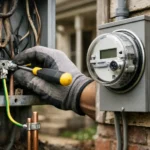
A breaker that will not reset, a burning odor at the panel, or half a house suddenly without power is not the time to hire based on the first paid ad that appears. A useful emergency electrician review looks past a fast arrival claim and asks whether the electrician can identify the actual hazard, make the area safe, and perform a repair that will hold up to inspection and daily use.
For homeowners, landlords, buyers, and property managers in older East Bay buildings, this matters even more. Oakland, Berkeley, Piedmont, and Lafayette have plenty of homes with aging panels, undersized services, ungrounded wiring, fuse boxes, knob-and-tube wiring, and past repairs that were never done correctly. An emergency can expose a problem that has been building for years.
Start With Safety, Not the Review Score
Before calling anyone, decide whether the condition requires emergency services or the utility company instead of an electrician. If there is active fire, smoke, sparking that will not stop, a downed power line, or someone has received an electrical shock, get people clear of the area and call 911. Do not open the panel, pull a meter, touch damaged wiring, or use water near electrical equipment.
If the issue is a neighborhood outage, check whether nearby homes are also dark. That may be a PG&E problem rather than a failure inside the building. An electrician is the right call when the outage is isolated to your property, the main breaker has failed, a circuit is overheating, or a service component appears damaged. A qualified contractor can also determine where utility responsibility ends and customer-owned equipment begins.
A five-star rating is useful, but it does not replace this first judgment. The best emergency response is the one that prevents a dangerous situation from getting worse.
Emergency Electrician Review: What to Look For
Read recent reviews for details, not just star counts. A review saying “great service” tells you very little. A review describing a failed main breaker, a burned bus bar, a tripping GFCI circuit, or a partial outage gives a clearer picture of the work performed and how the electrician handled it.
Look for evidence that the electrician explains the diagnosis in plain language. Electrical troubleshooting should not be guesswork. A competent electrician should be able to tell you whether the problem is a failed breaker, a loose connection, an overloaded circuit, water intrusion, damaged service equipment, or a fault downstream in the wiring.
The strongest reviews usually mention practical behavior: the electrician arrived when promised, identified the source of the problem, gave options, protected the property, and left the repair area safe. For urgent work, communication matters almost as much as speed. You need to know what failed, what was repaired, what still needs attention, and whether it is safe to turn the power back on.
Read for Similar Problems, Not Just Similar Homes
A homeowner with a flickering kitchen light does not necessarily need the same electrician as a property owner with a burned 100-amp panel. Search reviews for problems similar to yours. Terms such as “main panel,” “service upgrade,” “power outage,” “breaker replacement,” “burning smell,” “Federal Pacific,” “Zinsco,” “fuse panel,” “grounding,” and “inspection repair” can be more meaningful than generic praise.
This is especially important with obsolete or hazardous panels. Federal Pacific/Stab-Lok and Zinsco equipment have a long history of safety concerns. A breaker may appear to be on while failing to protect the circuit properly. Replacing a single part is not always the responsible answer when the entire panel has reached the end of its service life.
Confirm Licensing, Insurance, and Relevant Experience
An emergency electrician should be licensed, bonded, and insured. Ask directly, particularly when the repair involves a main service panel, meter equipment, damaged feeder conductors, or a possible service upgrade. These jobs can involve permits, inspections, coordination with PG&E, and code requirements that a handyman or unqualified installer cannot properly manage.
Experience should match the type of emergency. Replacing a receptacle is different from diagnosing a hot neutral, repairing an overloaded panel, or correcting a service issue. An electrician who regularly works on older East Bay electrical systems will recognize problems that can be missed during a rushed visit, including double-tapped breakers, corroded panel interiors, improper grounding, aluminum wiring connections, and overloaded subpanels.
For example, Williams Electric is led by Geoff Williams, a licensed electrician with decades of field experience in panel changes, PG&E service work, outage troubleshooting, and older electrical systems. That kind of specialized experience is valuable when an apparent small repair points to a larger panel or service problem.
Ask the Questions That Expose the Real Scope
You do not need to be an electrician to ask direct questions. When you call, describe symptoms accurately: which areas lost power, whether breakers are tripping, whether there is heat or odor, and whether work was recently performed. Then ask what the electrician expects to inspect and whether there is an emergency service charge.
A professional should not promise a final diagnosis before seeing the equipment. Still, they should be able to explain their process. In many cases, that means checking voltage at the service and panel, inspecting breakers and connections, tracing the affected circuit, looking for heat damage, and testing protective devices such as GFCIs and AFCIs.
Ask whether the repair is a temporary restoration or a permanent correction. There are times when restoring power safely is the immediate priority and a larger repair must be scheduled later. That is reasonable, provided the electrician clearly identifies the remaining risk and does not represent a temporary measure as a complete repair.
Price Matters, but So Does the Repair Standard
Emergency electrical work often costs more than scheduled daytime service because it disrupts the electrician’s schedule and may require immediate parts sourcing. That does not mean pricing should be vague. Before work starts, ask about the diagnostic fee, hourly or flat-rate structure, emergency surcharge, material costs, permit needs, and what authorization is required if the scope expands.
The lowest quote can be expensive if it leads to a second visit, a failed inspection, or another outage. On the other hand, not every tripped breaker requires a panel replacement. A trustworthy electrician explains the evidence behind the recommendation. If a panel is burned, obsolete, water-damaged, or unsafe, replacement may be the correct long-term decision. If the fault is confined to one damaged breaker or branch circuit, a focused repair may be enough.
Be cautious if an electrician refuses to discuss pricing at all, pressures you to approve a major upgrade immediately, or cannot explain why the proposed repair is necessary. Urgency should never be used as a substitute for a clear diagnosis.
Warning Signs in an Emergency Electrical Call
Some problems should end the conversation before work begins. Watch for these four warning signs:
- The person will not verify an electrical license or insurance coverage.
- They offer to bypass a breaker, remove a safety device, or use an oversized breaker to stop nuisance tripping.
- They dismiss visible heat damage, corrosion, or a burned odor without opening and inspecting the affected equipment safely.
- They demand full payment before providing a diagnosis, scope of work, or any explanation of the repair.
An oversized breaker is a particularly serious shortcut. Breakers are designed to protect wiring from overheating. Installing a larger breaker on an undersized conductor can create a fire risk while making the nuisance trip appear solved.
After the Repair, Review the Work Yourself
A good emergency electrician review can also help the next homeowner make a better decision. After the job, ask for a clear description of the cause, the parts replaced, any permit or inspection requirements, and recommendations for future work. Keep the invoice with your property records, especially if the job involved a main panel, service equipment, grounding, or a code correction.
Pay attention over the next few days. Breakers should remain stable under normal use. Lights should not flicker. Receptacles should not feel warm. If the original symptoms return, call promptly rather than repeatedly resetting a breaker or waiting for the next outage.
The right emergency electrician does more than get the lights back on. They leave you with a safer electrical system, a clear explanation of what happened, and an honest answer about what needs to be addressed next.