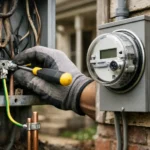
When half the house goes dead but the other half still works, that is not a normal outage. It is usually a sign that one leg of your electrical service has failed, a main breaker is damaged, a utility connection is compromised, or a serious wiring problem is developing. If you need to know how to diagnose partial power loss, the first job is figuring out whether the problem starts at the utility, the main service equipment, or a branch circuit inside the building.
Partial power loss can look strange. Kitchen lights may work while bedrooms are dark. The electric range may seem weak. A dryer may run but not heat. Some 120-volt circuits may be dead while a few 240-volt loads act erratically or stop altogether. In older homes, especially ones with outdated panels, aluminum connections, or long-deferred repairs, this symptom needs to be taken seriously.
What partial power loss usually means
Most homes in California are fed by split-phase power. You have two hot legs coming in from the utility and each leg carries about 120 volts to neutral. Across both legs, you get 240 volts for loads like dryers, ranges, and some HVAC equipment. If one leg drops out, half the panel may lose power. The circuits on the remaining leg may still operate, which is why the house is not fully dark.
That missing leg can happen for a few different reasons. A utility service conductor may have failed. A meter socket may have a burned connection. A main breaker may be damaged internally. A bus bar in the panel may be burned or loose. In some cases, the issue is limited to one multiwire branch circuit or a failed neutral, but the symptoms can overlap enough that guessing is a bad idea.
How to diagnose partial power loss without making it worse
Start with observation, not disassembly. If you smell burning, hear buzzing at the panel, see flickering that changes when appliances turn on, or notice a hot panel cover, stop there and call a licensed electrician or the utility. Those are danger signs, not troubleshooting signs.
If there is no sign of overheating, check whether the outage affects the whole property or just part of it. Look at neighboring homes. If they are dark too, the utility may already know about the outage. If your neighbors have power and your house has only partial power, the problem is more likely on your service or inside your electrical system.
Next, identify what is dead and what still works. Do not skip this step. The pattern matters. If every other breaker position seems affected, that points toward a lost service leg or a panel-level problem. If only a bathroom, garage, and one bedroom are out, that may be a branch circuit issue instead.
Try resetting individual breakers that appear tripped, then the main breaker only if it is safe to do so and there is no sign of damage. Reset once. If the breaker trips again or feels loose, do not keep cycling it. Repeated resets can make a bad breaker, a failing panel connection, or a short circuit worse.
Signs the utility side may be the problem
One of the most common causes of partial power loss is a utility issue upstream of the main panel. A bad service drop connection, a damaged underground lateral, or a failed transformer connection can leave you with one good leg and one dead leg.
A few clues point that way. Several large 240-volt appliances stop working at the same time. Half the lighting and receptacles are out across multiple areas of the building. The main breaker is on, branch breakers are on, but power is still missing in a broad pattern. In overhead service areas, weather damage, tree contact, or worn service connections are common suspects. In underground service areas, failed splices and damaged conductors can do the same thing.
This is where experience matters. A licensed contractor who understands both overhead and underground PG&E service work can tell whether the problem is likely utility-side or customer-owned equipment. That saves time and avoids the common mistake of calling the wrong party first.
Panel problems that cause partial power loss
If the utility feed is intact, the next place to suspect is the main service equipment. This includes the main breaker, bus bars, meter socket, service lugs, and panel connections.
A failed main breaker can pass one leg and lose the other. A burned stab connection can kill power to one section of the panel. Corrosion in the meter socket can create heat and intermittent loss. Older Federal Pacific, Zinsco, fuse panels, and heavily worn legacy panels are especially known for dangerous failure patterns. Some do not trip when they should. Others overheat, arc, or lose connection without an obvious external sign.
If lights brighten in one room when another appliance turns on, or electronics act strangely during the outage, do not ignore that. Those can be signs of a neutral issue, which can damage appliances quickly. A loose or failed neutral is different from a lost hot leg, but from the homeowner side it can look similar at first. Both require proper voltage testing by someone who knows what they are measuring.
How an electrician confirms the source
This is where basic homeowner observation stops and actual diagnosis starts. An electrician will typically test voltage at the line side and load side of the main breaker, check for full voltage across both hot legs, verify voltage from each leg to neutral, and inspect for heat damage, arcing, or failed terminations.
If one incoming leg is dead before it reaches the main breaker, the utility or service conductors are the likely problem. If voltage is present at the line side but missing at the load side, the main breaker may have failed. If the breaker is passing power but one bus section is dead, the panel itself may be damaged. If panel voltage looks normal but certain circuits are dead, the problem may be on a branch circuit, a splice, a receptacle feed-through, or a subpanel connection.
This kind of testing is not trial and error. It has to be done methodically and safely, especially in older homes where previous work may be undocumented or incorrect.
When partial power loss is only on one circuit
Not every partial outage means a service failure. Sometimes the problem is isolated to one branch circuit, and the symptoms just feel bigger because that circuit feeds several rooms. A tripped AFCI or GFCI device, a failed backstab receptacle, a loose wirenut in a junction box, or a burned connection at a switch can shut down part of the house.
The difference is pattern. A single branch circuit problem usually follows the path of one circuit and does not affect major 240-volt appliances. A service leg problem usually cuts across unrelated rooms and loads. That distinction helps narrow the diagnosis fast.
What not to do
Do not remove the panel cover unless you are qualified to work inside energized equipment. Do not jam breakers harder because one feels weak. Do not replace a breaker with a larger size to see if it holds. Do not assume the utility is at fault just because the outage affects multiple rooms. And do not keep using appliances while lights are dimming, brightening, or flickering unpredictably.
Those symptoms can point to loose service conductors, failing breaker connections, or neutral problems that can destroy electronics and start fires. Partial power loss is one of those complaints that can go from inconvenient to dangerous quickly.
When to call right away
Call immediately if you have a burning smell, smoke, crackling at the panel, melted breakers, a hot meter socket, or visible arcing. Also call if the building has an older hazardous panel, especially Federal Pacific or Zinsco equipment, because those systems have a long history of unsafe behavior under fault conditions.
In many East Bay homes, especially older properties in Oakland, Berkeley, Piedmont, and nearby neighborhoods, partial power loss ends up exposing a bigger issue: outdated service equipment, undersized panels, failed terminations, or unsafe prior electrical work. The outage is often just the symptom that finally gets attention.
A seasoned local contractor like Geoff Williams Electric has seen this pattern for decades on service calls, panel changes, and utility coordination work. The right fix might be a utility repair, a breaker replacement, a meter socket repair, or a full panel upgrade. It depends on what testing shows, not what the symptom seems to suggest.
If your home or building has partial power loss, treat it as a real electrical fault, not a minor inconvenience. The useful first step is to observe the pattern, shut down risky loads, and get the system tested before the damage spreads.