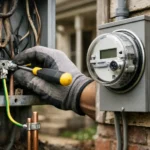
A Federal Pacific Stab-Lok panel can look perfectly normal while creating a serious safety concern behind its cover. If you are researching how to replace a Stab-Lok panel, the first point is simple: this is not a breaker swap or a weekend homeowner project. A proper replacement involves a permitted service shutdown, correct equipment sizing, utility coordination when required, grounding and bonding work, and a final inspection.
Federal Pacific Electric panels and Stab-Lok breakers are widely known in the electrical trade because certain breakers have been reported to fail to trip under overload conditions. That means a circuit may continue carrying dangerous current instead of shutting down as designed. Not every panel shows visible damage, but a clean-looking panel is not proof that it is safe.
Why Stab-Lok Panel Replacement Should Not Wait
A circuit breaker has one basic job: open the circuit when there is an overload or short circuit. If that protection does not operate reliably, wiring and connected equipment can overheat. In an older East Bay home, the risk can be compounded by aging cloth wiring, ungrounded receptacles, overloaded additions, old fuse equipment, or previous unpermitted work.
Warning signs deserve immediate attention. These include a hot panel cover, a burning odor, discoloration around breakers, buzzing, breakers that will not reset, lights that dim when appliances start, or repeated tripping. But the absence of those symptoms does not make a Stab-Lok panel a good candidate to keep. Many homeowners replace these panels during a real estate sale, remodel, EV charger installation, insurance renewal, or after an inspection report identifies the equipment.
Replacing the panel also gives a qualified electrician a chance to correct conditions that may have been hidden for decades: improper double-tapped breakers, missing grounding, damaged service conductors, incorrect breaker sizes, open knockouts, and circuits with no clear labeling.
How to Replace a Stab-Lok Panel: The Proper Process
The exact work depends on whether the existing panel is only a distribution panel or includes the main service disconnect and meter equipment. It also depends on the home’s electrical demand, the condition of the service entrance, and the local utility connection. Still, a professional panel change follows a predictable sequence.
Start with an on-site electrical assessment
A licensed electrician should inspect the panel, meter location, service conductors, grounding electrode system, branch-circuit wiring, and available working clearances. The electrician will identify the panel’s amperage, determine whether the existing service can support the replacement, and calculate whether a larger service is needed.
A straight replacement may make sense when a 100-amp service is in good shape and the home has modest electrical loads. A 200-amp service upgrade may be the better long-term choice if the property is adding an EV charger, heat pump, induction range, air conditioning, electric water heating, an accessory dwelling unit, or major remodeling loads.
This is where experience matters. Installing a larger panel without confirming the utility service, feeder capacity, and load calculation is not an upgrade. It is an expensive mismatch.
Pull the permit before work begins
Panel replacement work normally requires an electrical permit and inspection. The permit protects the property owner by requiring the work to meet current safety rules rather than simply making the new panel look neat.
The permit scope may include the panel only, or it may include service equipment, grounding upgrades, meter work, or a full service upgrade. Local requirements vary, particularly with older homes in Oakland, Berkeley, Piedmont, and nearby communities where service configurations can be unusual.
Do not accept a proposal that treats the permit as optional for a safety-critical panel replacement. Skipping it can create problems during a sale, insurance review, refinance, or future electrical work.
Coordinate the shutdown and utility work
The old panel must be de-energized before it can be removed. If the work is on the service equipment, the utility may need to disconnect power at the meter or transformer, depending on the configuration.
For a PG&E service upgrade, scheduling and documentation can be a significant part of the job. Overhead and underground services have different requirements. A contractor must know where the customer’s responsibility ends, what utility equipment must remain untouched, and when utility approval or field coordination is required.
A qualified contractor plans this before the day of installation. The goal is to avoid a job that begins with the power off and then stops because of an unexpected service issue, a damaged meter socket, insufficient conductor length, or missing utility clearance.
Install modern listed equipment and safety protection
The replacement panel should be properly rated for the service and installed with breakers listed for that specific panel. Breakers are not universal parts. Using a breaker that merely fits physically is not acceptable.
Modern code may require AFCI and GFCI protection for certain circuits. AFCI breakers help reduce fire risk from arcing faults, while GFCI protection helps protect people from shock in wet or grounded locations. Older homes often need some circuit tracing and troubleshooting before these protections can be added successfully.
The electrician should also verify neutral and ground separation where required, install correct grounding electrode connections, protect cables and conduits properly, close unused openings, and label every circuit clearly. Good labeling is more than a convenience. It makes future troubleshooting safer and faster.
Inspect, energize, and test the system
After installation, the work should be inspected as required by the permit. Once approved and energized, the electrician should test voltage, verify the main disconnect and branch circuits, check grounding and polarity where applicable, and confirm that the panel directory matches the circuits.
Some older branch circuits may reveal separate problems after the panel change. For example, a new AFCI breaker may trip because of damaged wiring, shared neutrals, or an old wiring connection. That does not mean the new breaker is defective. It often means the replacement panel has exposed an existing condition that needs correction.
Choosing Between a Panel Change and a Service Upgrade
A Stab-Lok replacement does not automatically require a 200-amp service upgrade. The right choice depends on the load calculation and future plans.
If the existing service is in good condition, has enough capacity, and the property does not anticipate major new electric loads, replacing the dangerous panel with a modern panel of similar capacity can be a sensible option. It may reduce project cost and avoid unnecessary utility work.
On the other hand, staying at 100 amps can be shortsighted when a homeowner plans to electrify appliances, install EV charging, or add living space. A panel with plenty of breaker spaces does not create more service capacity. The service conductors, meter equipment, main disconnect, and utility supply must all support the calculated load.
Ask for a clear explanation of both options. A good electrician will explain the trade-offs rather than automatically selling the biggest panel available.
What Homeowners Should Do Before the Electrician Arrives
You do not need to remove the panel cover or test breakers yourself. In fact, avoid disturbing the panel. Take clear photos of the outside of the panel, the panel label if visible without removing covers, the meter area, and the service entrance. Note any symptoms such as heat, odor, flickering lights, or tripping breakers.
Clear the required working area around the panel. Avoid scheduling a panel replacement on the same day as a critical work-from-home deadline, medical equipment need, or a business operation that cannot tolerate an outage. Most replacements involve a planned power interruption, and service upgrades can take longer if utility scheduling is involved.
If you are buying or selling a property, get the panel evaluated early in the transaction. Waiting until the final days of escrow can put unnecessary pressure on a job that may require permits, inspection, or PG&E coordination.
Questions Worth Asking a Panel Replacement Contractor
Ask whether the contractor is licensed, bonded, and insured; whether permits and inspection are included; whether the quote covers grounding and bonding corrections; and whether the contractor has direct experience with Federal Pacific Stab-Lok equipment and PG&E service work. Also ask what happens if the electrician finds damaged branch wiring or an undersized service after opening the panel.
The lowest estimate is not always the lowest final cost. A vague proposal may leave out permit fees, utility coordination, breaker upgrades, panel relocation work, stucco repair, or corrections required for inspection. Get the scope in writing.
Geoff Williams has been a licensed electrician since 1987 and has handled safety-critical Federal Pacific and Stab-Lok panel changes throughout the East Bay for decades. For this kind of work, proven experience with older electrical systems matters as much as the new panel itself.
A Stab-Lok panel is not the place to wait for a failure that provides the warning. Schedule a qualified evaluation, understand whether a panel replacement or full service upgrade fits the property, and have the work permitted, inspected, and completed correctly.