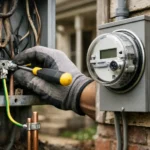
Geoff Williams has personally finished over 2,500 PG&E main panel changes, and is experienced with local city inspectors, and local PG&E reps. If you are asking, “How important is it that your electrician have a lot of experience with local inspectors, and local PG&E reps, when it comes down to changing your main service PG&E service entrance panel?” the short answer is: very important. Not because your electrician needs to be friends with anybody, but because this kind of job is not just a panel swap. It is a utility coordination job, a permit job, an inspection job, and a safety job all at the same time.
A main service change is one of the few residential electrical projects where mistakes can leave you without power, fail inspection, delay a closing, or force expensive rework. On older East Bay homes, that risk goes up even more. You may have outdated grounding, old meter equipment, overhead service conductors, underground complications, Federal Pacific or Zinsco equipment, or code issues that do not show up until the wall is open and the panel is off.
Why local experience matters on a PG&E service entrance panel change
A service entrance panel change has moving parts that do not exist on a simple breaker replacement or branch circuit repair. Your electrician has to know what the city inspector is likely to flag, what PG&E requires before reconnecting service, how to schedule the sequence correctly, and how to build the job so it passes the first time.
That local knowledge saves time because every jurisdiction has patterns. The code is the code, but the way it gets enforced can vary. One inspector may be particularly strict about meter height, working clearance, grounding electrode conductor routing, or labeling. Another may focus on bonding details, service mast support, or whether the service equipment is correctly rated and grouped. An electrician who works in that area all the time usually knows what will get questioned before the inspector ever arrives.
The same goes for PG&E. Utility requirements are not a guess. The electrician needs to know how PG&E wants the service prepared, whether the existing drop or lateral may need attention, what paperwork or utility coordination is needed, and what can hold up reconnection. If that is handled badly, the homeowner can end up sitting in the dark waiting for a correction.
This is not about favoritism
Some homeowners hear “experience with local inspectors” and think it means back-channel favors. That is not the point.
A good electrician does not need special treatment. He needs a solid working understanding of how local inspection and utility processes actually work in the field. That means submitting the right permit, using approved equipment, setting the service correctly, preparing for common correction items, and communicating clearly when there is an issue.
Inspectors generally respect electricians who do clean work, know the code, and do not waste their time. PG&E reps appreciate contractors who understand utility standards and do not create avoidable call-backs. That kind of professional history matters because it reduces friction, not because anybody is getting a shortcut.
Where inexperienced contractors get into trouble
The biggest problems on panel change jobs usually come from underestimating the scope. A homeowner may think, “We are just replacing the old panel with a new one.” In many homes, that is not what happens.
Once the old main service equipment comes off, hidden defects often show up. The grounding may be undersized or missing. The meter socket may not be acceptable. The riser may be damaged. The service mast may not meet current support requirements. The panel location may not have legal working clearance. On underground services, the conduit path or pull condition may become part of the job.
An electrician without deep service upgrade experience can get stuck fast. He may install the panel but miss a utility requirement. He may pass part of the city inspection but fail on service details. He may schedule badly and create a power outage that lasts longer than expected. He may also quote too low because he does not recognize the real risk in an older service change.
That is where local experience pays for itself. Not because the job becomes simple, but because the surprises are more predictable.
Local inspectors can affect your timeline more than you think
If you are selling a house, buying one, replacing a dangerous panel, or trying to upgrade from 100 amps to 200 amps, time matters. A failed inspection can cost more than the reinspection fee. It can delay move-in, hold up escrow repairs, postpone other contractors, and create scheduling problems with PG&E.
A seasoned local electrician usually knows how to stage the work to keep that timeline tight. He knows when to pull the permit, when to coordinate shutoff and reconnection, when to have corrections already addressed before inspection, and when to tell the customer that another problem may affect the schedule.
That kind of planning is hard to fake. It comes from doing service changes over and over in the same utility territory and dealing with the same cities, same housing stock, and same field conditions.
Older homes make local knowledge even more valuable
In Oakland, Berkeley, Piedmont, and similar areas, many properties have electrical systems that were never designed for modern loads. You might see old fuse panels, obsolete breaker panels, ungrounded circuits, mixed wiring methods, damaged meter sockets, or service equipment that has been altered multiple times over decades.
That matters because the panel change often becomes the moment when old work gets exposed. Some of it can stay if it is legal and safe. Some of it has to be corrected. An electrician who works on older East Bay homes regularly has a better feel for what is likely to be there and how to fix it without turning the whole project into chaos.
He also knows when a panel replacement should really be treated as a service upgrade, when existing conditions will trigger more work, and when a dangerous legacy panel like Federal Pacific or Zinsco should not be delayed any longer.
Experience with PG&E reps helps avoid utility-side surprises
One of the biggest homeowner misunderstandings is assuming the electrician controls the whole job. He does not. PG&E controls the utility side. That means coordination matters.
An electrician with real PG&E service entrance experience knows the difference between house wiring work and utility interface work. He understands overhead versus underground service issues, meter and service equipment requirements, and what must be ready before PG&E can safely reconnect.
This becomes even more important on 200-amp upgrades, damaged service replacements, and jobs where the existing setup is old or nonstandard. If the electrician does not know how PG&E is likely to respond, the homeowner becomes the one paying for delay and confusion.
What you should ask before hiring
You do not need to interview an electrician like a lawyer, but you should ask direct questions. How many main service panel changes have you done locally? Do you regularly handle PG&E service coordination? Have you worked with both overhead and underground services? Who pulls the permit? Who handles the inspection? What conditions commonly turn a basic panel change into a larger repair?
Listen to how the answers sound. A real service electrician will usually answer plainly and specifically. He will talk about grounding, meter equipment, service conductors, inspection corrections, timing, and utility coordination. A less experienced contractor often stays vague and keeps bringing the conversation back to the panel brand or the breaker count.
That is a warning sign. The panel itself is only part of the job.
Does local experience always matter equally?
No. If the job is straightforward, the service location is clean, the existing equipment is modern enough, and the electrician is a strong service contractor even without long history in your city, the job may still go fine. Good electricians can read requirements, follow code, and do proper work.
But when the project involves an older property, a service upgrade, permit pressure, real estate deadlines, underground complications, dangerous legacy equipment, or any risk of utility-side delay, local experience starts mattering a lot more. That is where field judgment makes the difference between a smooth one-day outage and a drawn-out problem.
For homeowners and property managers, the practical question is not whether a less experienced electrician can do the work. It is whether you want your main service panel change to be his learning experience.
The safer bet on a main service panel change
The safer bet is an electrician who has done this specific work many times, in your utility territory, under your local inspectors, on the kind of buildings common in your area. That is especially true when the job involves a PG&E service entrance panel, a 100-amp to 200-amp upgrade, or replacement of obsolete and hazardous equipment.
This is one of those jobs where the cheapest number on paper can become the most expensive number later. Experience reduces avoidable mistakes. Local experience reduces avoidable delays. And when your house power, safety, and permit sign-off all depend on the same project, that is not a small advantage.
A contractor like Geoff Williams, with decades of service work and direct PG&E system contractor registration, brings the kind of field-tested judgment that matters when a panel change is more than just swapping breakers. If you are hiring for this kind of work, look for somebody who already knows the road, not somebody asking for directions after the power is off.