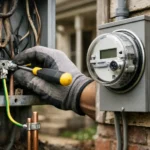
If you have an old dangerous panel in your closet, how do you remove it, given the wires are all over, install a new panel that is often much bigger than the older panel, and is it legal NEC-wise to leave it in the closet? The short answer is this: in most cases, you do not simply swap it in place. A panel in a clothes closet is usually a code problem, a safety problem, or both, and the wire layout often makes the job more involved than homeowners expect.
This comes up all the time in older homes with Federal Pacific, Zinsco, fuse panels, or undersized 100-amp equipment. The panel may have worked for decades, but that does not make it safe, and it does not mean it can stay where it is when you replace it. Once you open the wall and start dealing with conductor length, service clearances, grounding, AFCI and GFCI protection, and utility coordination, it becomes a real panel change – not a cosmetic upgrade.
Is it legal NEC-wise to leave a panel in a closet?
For a new installation, the answer is no. The National Electrical Code does not allow overcurrent devices in the vicinity of easily ignitable material, including clothes closets. A panelboard with breakers in a clothes closet is not an acceptable location for a new panel installation.
That is the key distinction. An old panel may still be there because it was installed under older rules, local enforcement was different, or nobody corrected it during past remodels. Existing does not mean compliant for replacement. Once you replace service equipment or a panelboard, the work generally has to meet current code requirements, permit requirements, and local inspection standards.
There is also the working space issue. Electrical panels need proper depth, width, and headroom clearance. A typical closet full of shelves, hanging clothes, storage boxes, or sliding doors usually fails that test. Even if the panel is technically accessible, inspectors look at whether a person can safely work on it and whether combustible storage is crowding the equipment.
So when people ask if they can just leave the new one in the closet because the old one was there, the honest answer is usually no.
What happens when the old dangerous panel is in a closet and wires are everywhere?
This is where experience matters. On older homes, the conductors often enter from every direction. Some come from the attic, some from the crawl space, some through finished walls, and some may be spliced or extended in ways that should have been corrected years ago. The old panel may be physically small, but the wiring around it is often packed too tightly.
A modern replacement panel is commonly taller, wider, or deeper. A 200-amp panel upgrade especially takes more room than an old fuse box or obsolete breaker panel. You cannot safely force all those existing branch circuits into a bigger can without planning the routing, bending space, cable protection, and splice access.
In practical field terms, there are usually three paths.
The best path is relocation. That means moving the new panel to a code-compliant wall with proper working clearance and extending or rerouting circuits as needed. This may involve opening drywall, fishing new conductors, adding junction boxes where permitted and accessible, and coordinating the service entrance conductors, grounding electrode system, and utility disconnect requirements.
The second path is a meter-main or service equipment reconfiguration outside, with an interior distribution panel placed in a legal location. That can solve several problems at once, especially when the old closet location is impossible and the service is also undersized.
The third path is partial rework with heavy wire extension, but only if the final panel location is compliant and all splices remain accessible. Hidden splices buried in a wall are not allowed. Neither is turning a closet into a disguised electrical room by removing a shelf and hoping nobody notices.
How an electrician actually removes and replaces it
The removal itself is not the hard part. The hard part is making the new installation safe, code-compliant, and serviceable for the next 30 years.
First, the electrician evaluates the service size, panel condition, available wall space, grounding, circuit count, and the path of every major feeder and branch circuit. Dangerous legacy panels often show overheating, double taps, damaged bus bars, failed breakers, corrosion, and makeshift wiring corrections. In many older East Bay homes, the panel problem is tied to other defects such as ungrounded circuits, old cloth wiring, or missing bonding corrections.
Next comes design. If the closet location is not legal for the replacement panel, the electrician determines the nearest practical code-compliant location. That might be on the opposite side of the same wall, in a garage, on an exterior wall, or in another utility area with proper clearance. If the service is being upgraded from 100 amps to 200 amps, this step also includes utility requirements, service mast or underground coordination, and load calculations.
After that, circuits are identified and mapped. This matters because once the old panel is out, every conductor has to land correctly in the new equipment. Short wires are common. When conductors will not reach the new panel, they must be extended in a legal way, usually through accessible junction boxes or by rerouting and replacing segments of cable.
Then power is shut down and the old panel is removed. If it is service equipment, this involves utility coordination and permit work. The new panel is mounted in the new location, service conductors and grounding are corrected, and the branch circuits are brought in cleanly with proper connectors, arc protection where required, and breaker sizing matched to conductor ampacity.
Finally, the system is tested, labeled, and inspected. A proper panel change is not just about getting the lights back on. It is about eliminating hazards that often were hidden behind the dead front for years.
Why the new panel is often much bigger physically than the old one
Older panels were often undersized by modern standards. Homes now have more kitchen loads, more bathroom circuits, HVAC upgrades, tankless water heaters, home offices, induction cooking, EV charging, and accessory structures. Even if the main service stays the same, the number of required spaces usually increases.
Modern code also drives size. You may need more dedicated circuits, surge protection, AFCI breakers, GFCI breakers, isolated neutrals, and room for future expansion. A panel that looked fine in 1965 can be completely inadequate now.
There is also a practical reason veteran electricians prefer a panel with extra capacity. A panel crammed to the limit on day one is a bad value. If you add air conditioning, a heat pump, or a Tesla charger later, the panel should have the space and ampacity to handle it without another major rework.
Can the old closet opening just be patched after relocation?
Usually, yes. Once the new panel is relocated, the old opening can be removed from service and the wall repaired. But any splice boxes created during the reroute must remain accessible. You cannot use the old panel cavity as a hidden splice chamber and then drywall over it.
Sometimes the cleanest solution is to install a junction cabinet in a legal accessible area near the old wiring concentration and then route feeders or branch extensions to the new panel. That depends on how the circuits were originally run and how much wall access is available.
When this turns into more than a panel change
Homeowners often start by asking about one dangerous panel and end up dealing with a larger safety correction. That is normal. If the old panel is in a closet, there is a fair chance the house also has other age-related electrical issues. Common examples are two-wire branch circuits with no equipment grounding conductor, oversized breakers, multi-wire branch circuits wired incorrectly, deteriorated service conductors, and old subpanels with neutral-ground bonding errors.
This is why the cheapest bid can become the most expensive mistake. A panel replacement done without correcting the surrounding defects may pass current to old hazards instead of removing them.
What homeowners should expect before approving the work
A good estimate should explain whether the panel can legally remain where it is, whether relocation is required, whether drywall access will be needed, and whether a 100-amp to 200-amp service upgrade makes sense. It should also spell out permit and inspection requirements, utility coordination, grounding upgrades, and any known branch-circuit issues.
If someone proposes putting a brand-new breaker panel back into a clothes closet because the old one was there, that is a red flag. The same goes for vague promises to “make the wires reach” without describing how. Electrical work in older homes is full of hidden conditions, but the code basics on panel location are not mysterious.
For buyers, landlords, and agents, this issue is worth addressing before close of escrow if the panel is known to be Federal Pacific, Zinsco, or another failure-prone type. For owners planning remodels or EV charging, it is smart to solve the panel location and service size together instead of paying twice.
A dangerous panel in a closet is usually telling you two things at once: the equipment is outdated, and the location no longer works. The right fix is not just replacement. It is replacement in the right place, with the wiring cleaned up, permitted, and built to last.