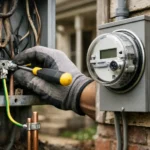
ON a shared neutral circuit, where two hots are sharing one white neutral wire, if the neutral gets loose, there will be 240 volts on both hot lines! In electrician land, that’s death and fire. Lights getting unusually bright in one room and dim in another is not a nuisance problem. It is one of the classic signs of an open neutral, and it can damage appliances, overheat wiring, and create a real fire hazard. If you are searching for how to correct open neutral wiring, the first thing to know is this – the repair depends entirely on where the neutral opened up, and guessing is how people make a bad situation worse.
What an open neutral actually means
In a typical 120-volt branch circuit, the hot conductor brings power out and the neutral carries current back. When that neutral path is broken somewhere in the circuit, devices may stop working, work intermittently, or behave erratically. On a multi-wire branch circuit, an open neutral can be even more serious because voltage can swing unevenly across connected loads.
That is why an open neutral is not just a dead outlet issue. You may see flickering lights, half-working receptacles, buzzing electronics, or burned connections. In older homes, especially homes with aging receptacles, aluminum wiring repairs, backstabbed devices, or previous handyman work, this problem shows up more often.
How to correct open neutral wiring safely
The safe way to correct open neutral wiring starts with diagnosis, not replacement. You do not fix this by randomly swapping outlets until something comes back on. The neutral can open at a receptacle, a switch box, a junction box, the panel, the service equipment, or even at the utility side in some cases.
Start by paying attention to the symptoms. If only one outlet is dead, the problem may be local. If several outlets and lights on the same circuit are acting strange, the open neutral is often upstream at the last working device or at a splice. If the whole house has flickering, brightening, and dimming on different circuits, that points to a service neutral problem, and that needs immediate professional attention.
Before touching anything, shut off the affected circuit and verify power is off with a reliable tester. A non-contact tester is useful as a quick check, but it should not be your only check. For real troubleshooting, you need a meter and enough experience to interpret what it is telling you.
Common places an open neutral is found
Most open neutral faults come from loose terminations, failed backstab connections, wirenut splices that have loosened over time, damaged conductors, or burned device terminals. In older East Bay properties, it is also common to find mixed-age wiring, partial remodels, and overloaded circuits with repairs done in stages over decades.
A receptacle that uses push-in backstab connections is a repeat offender. Those terminations can loosen with heat cycling and age. Another common failure point is a shared neutral circuit where someone replaced a device incorrectly and disturbed the neutral continuity. In some homes, the trouble is in an attic or crawl space junction box that was buried, overloaded, or poorly spliced.
At the panel, a loose neutral on the neutral bar can cause intermittent circuit problems. At the service, a failing utility neutral can create dangerous voltage imbalance throughout the building. That is the kind of problem that can burn up electronics quickly.
Step-by-step troubleshooting for an open neutral
The practical approach is to find where the neutral path stops being continuous. Usually, you begin at the affected area and work backward toward the source.
If one receptacle is dead but others nearby still work, check the last working receptacle and the first dead one. Remove the devices after confirming the circuit is off. Look for a white neutral wire that is loose, burned, broken, or inserted into a backstab hole instead of secured under a screw terminal. If you find backstabbed neutrals, moving them to the side screws is often the right correction, provided the device itself is still in good condition.
If multiple outlets are affected, map out what is on that circuit. The failed connection is often at the first device in the run that feeds the dead section. Burn marks, melted insulation, or discolored terminals are strong clues. A receptacle can still appear normal from the front while the connection behind it is cooked.
With the power off, check wirenut splices in accessible junction boxes. A neutral splice that looks twisted together but was never properly made can fail under load. If copper is nicked, darkened, or brittle, cut back to clean conductor if there is enough slack and remake the splice correctly. If there is not enough wire length, then the repair may require extending conductors in an approved box, not forcing a marginal connection.
If your meter shows voltage readings that do not make sense, such as phantom voltage on a dead receptacle, be careful not to misdiagnose the issue. Open neutrals can create misleading readings. A loaded test and a continuity check with power off are more reliable than assuming a stray voltage means the circuit is live and intact.
What the actual repair usually involves
Once you find the failed point, the repair is usually straightforward but needs to be done cleanly. Replace burned or worn receptacles. Move all backstab terminations to screw terminals. Tighten neutral bar connections to manufacturer specs if the fault is in the panel and the conductor is otherwise sound. Redo bad splices with the correct connector and box fill. Replace damaged sections of conductor if heat or corrosion compromised the wire.
The key point is that the repair has to restore both mechanical strength and electrical continuity. A wire twisted loosely under a wirenut is not enough. A neutral landed under a screw with insulation caught under the terminal is not enough. On shared neutral circuits, conductors must be identified and reconnected properly, or you can create a worse problem than the one you started with.
This is where experience matters. A trained electrician is not just looking for the open neutral. He is also checking why it failed. Was the circuit overloaded? Is the device worn out? Is there aluminum wiring with improper terminations? Is there heat damage that points back to a Federal Pacific, Zinsco, or other unsafe panel condition? Sometimes the open neutral is the symptom, not the whole job.
When not to try fixing it yourself
There are a few cases where this should stop being a DIY project immediately. If lights are getting brighter and dimmer across different rooms, if 240-volt appliances are acting strangely, or if multiple circuits are affected at once, the service neutral may be loose or failing. That is urgent. Shut off sensitive electronics and call an electrician. If the fault is ahead of the main panel, the utility may need to be involved.
You should also step back if you find overheating at the panel, damaged bus bars, double-lugged neutrals where they do not belong, old cloth wiring, knob-and-tube transitions, or any sign that the wiring system has been altered repeatedly without a clear plan. Those are common inspection issues in older homes around Oakland, Berkeley, and Piedmont, and they call for a proper repair, not a guess.
How electricians verify the neutral is truly corrected
A good repair is tested, not assumed. After the connection is corrected, voltage should be stable from hot to neutral and hot to ground where appropriate. Devices on the circuit should operate normally under load. On multi-wire branch circuits, voltage balance and handle-tied or common-trip breaker requirements should also be checked.
An electrician will usually inspect the surrounding devices and connections too, because failures tend to cluster. If one outlet on an older circuit burned up from a loose neutral, the others may be worn or backstabbed as well. Replacing one failed part but leaving several weak links behind is how callbacks happen.
Williams Electric handles this kind of wiring correction the way it should be handled – find the bad connection, verify the circuit path, repair it to code, and make sure the problem is not tied to a larger panel or service issue.
Preventing the next open neutral problem
Open neutrals often show up in older devices that have been carrying load for decades. Prevention usually means tightening up the weak points before they fail. Replacing worn receptacles, correcting backstabbed wiring, repairing overheated splices, and updating unsafe panel equipment can save you from more expensive damage later.
If you bought a home with inspection notes about loose outlets, reversed polarity, two-prong receptacles, ungrounded circuits, or amateur electrical work, do not treat those as cosmetic issues. Many neutral problems start in exactly those locations. For landlords and property buyers, this matters even more because intermittent electrical faults tend to become emergency calls at the worst possible time.
The right fix for an open neutral is not the fastest patch. It is the repair that restores a safe return path, eliminates the failed connection, and confirms the rest of the circuit is sound. If the symptoms are isolated and simple, the correction may be small. If the neutral is failing at the service or panel, the job is bigger and more urgent. Either way, treat it with respect – electrical problems that look minor from the outside can tell a very different story once the cover plate comes off.