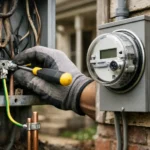
Does he call pg&e for a beast test? (When they hook up a meter to your system that draws 22 amps and proves it is not their fault, but on your end of the system.) A difficult electrical problem is rarely solved by guesswork. When a customer asks, “What does a master electrician go through when he is trouble shooting a difficult problem? How does he know it’s a burned wire, a loose wire, a PG&E problem and not on your end, a loose neutral, a missing hot strand, a bad splice, a bad outlet, a bad switch, a bad breaker, a burned hidden bus bar inside a buried panel? How do you know if he is willing to back off what he believed if he is wrong?” the real answer is simple: he follows evidence, not ego.
That is what separates a real trouble shooter from a parts changer. Anybody can replace a breaker, a switch, or an outlet and hope the problem goes away. A master electrician works differently. He narrows the fault down, tests one section at a time, compares what the readings should be against what they actually are, and keeps moving until the electrical story makes sense from the utility side all the way to the last device on the circuit.
What a master electrician is actually looking for
Electrical problems leave patterns. A loose neutral does not act the same way as a bad breaker. A burned wire does not usually act the same way as a utility feed problem. A bad splice may work for years and then fail only when a heavy load comes on. A damaged bus bar inside a panel can mimic other failures and waste a lot of time if the electrician does not know where to look.
The first job is not repair. The first job is separating symptoms from causes. Lights dimming in one room, half the house dead, random breaker tripping, one dead outlet in a string, voltage reading low on one leg, appliances acting strangely, or a panel that feels hot all point in different directions. Good troubleshooting starts with those clues.
A veteran electrician also pays attention to house age, panel brand, previous remodel work, aluminum wiring, underground vs overhead service, and whether the problem started suddenly or has been getting worse. Older homes in the East Bay often have layered repairs from different decades. That matters because the newest symptom is not always where the original defect is hiding.
How he knows if it is a PG&E problem or your problem
This is one of the biggest questions homeowners have, especially when part of the house is out or voltage seems unstable. The only honest way to answer it is by testing at the right points in the right order.
A master electrician starts at the service. He checks whether proper voltage is arriving from the utility. On a typical single-phase residential service, he wants to see the two hot legs and the neutral behaving correctly. If one hot leg is missing, weak, or dropping under load, that can point to a utility issue, a service conductor problem, a meter socket problem, or a failing main connection. If the service is good at the line side and bad farther in, the fault is on the customer side.
He does not just take one quick reading and call it done. Some failures only show up under load. A conductor can read fine with no demand and then collapse when the dryer, range, or microwave turns on. That is why a good electrician may test with circuits energized, with loads applied, and at several locations between the service point and the affected branch circuit.
If the utility feed is not stable, the evidence will usually show up before the branch circuit. If the service tests solid and the trouble starts after the main disconnect or in a subpanel, then PG&E is likely not the problem.
Burned wire, loose wire, loose neutral, or missing hot strand
These faults are related, but they do not behave exactly the same.
A burned wire often leaves heat damage, insulation discoloration, odor, brittle copper or aluminum, and a voltage drop that gets worse as current rises. The underlying cause may be a loose connection, corrosion, overfusing, a damaged device, or a high-load condition on a weak termination. Burn marks tell part of the story, but the electrician still has to ask why it burned.
A loose wire can produce intermittent failure. Push on the device and it works. Turn on a vacuum and it fails. Wiggle in the panel and the reading changes. That is why movement, load, and retesting matter.
A loose neutral is one of the more dangerous conditions because it can create unstable voltage. Lights may get unusually bright in one area and dim in another. Electronics may act erratically. On multi-wire branch circuits and service conductors, neutral problems can damage equipment fast. A master electrician knows that weird mixed symptoms often point to a neutral issue before anything else.
A missing hot strand, or one failing leg of the service, often shows up as half the panel or alternating circuits going dead. In some cases, 120-volt loads on one side are affected while the other side remains normal. That pattern pushes the investigation upstream toward the service conductors, meter, main breaker, or bus structure.
Bad splice, bad outlet, bad switch, bad breaker
This is where experience saves time. A bad outlet usually affects that location and maybe the downstream devices if the circuit is fed through it. A bad switch generally affects the switched load and not much else. A bad splice hidden in a junction box can kill everything beyond that point. A bad breaker may show proper voltage on one side and not the other, or it may fail only when warm.
But none of those should be assumed. They should be proven.
A master electrician isolates the circuit, identifies the last known good point and the first known bad point, and works between them. He may open devices, inspect terminations, test continuity when safe and appropriate, check for backstabbed receptacles, inspect wirenuts and mechanical lugs, and verify whether the breaker is actually delivering full voltage. If replacing a breaker does not fix the issue, he does not keep guessing. He reopens the case and rethinks the path.
That is what homeowners should want to see. Not confidence theater. Real troubleshooting.
The hidden problem: burned bus bar inside a buried panel
Some of the hardest failures are inside older panels where the damage is not obvious until covers come off and components are exposed. A burned hidden bus bar inside a buried panel can mimic a bad main breaker, a bad branch breaker, or a utility problem. You can lose a leg, get intermittent power, or see overheating at certain breaker positions.
This is especially important with older or known-problem equipment, including Federal Pacific, Zinsco, obsolete fuse panels, and heavily altered service equipment. Damage can be behind the breaker where the panel no longer makes safe contact. At that point, replacing just one breaker may do nothing because the real failure is the panel interior itself.
An experienced panel specialist knows when to stop treating the symptom and recommend panel replacement. That is not upselling if the bus is burned, the panel is obsolete, or the failure is embedded in the gear. It is the safer and more honest repair.
How do you know he will back off if he is wrong?
You know by how he works.
A real master electrician forms a working theory early, because that helps organize testing. But he does not fall in love with that theory. If the meter readings, load behavior, or circuit mapping prove him wrong, he changes direction. Good troubleshooting is not about defending the first opinion. It is about getting to the actual fault.
There are practical signs of this. He explains what he believes, what he has ruled out, and what still needs verification. He does not pretend certainty where certainty has not been earned. He rechecks unusual readings. He confirms the repair after the fix. If a problem has more than one cause, he says so.
That matters because difficult electrical problems often have stacked defects. A house can have a weak breaker and a loose neutral. A remodeled kitchen can have a bad splice and an overloaded legacy panel. A service issue can expose a branch circuit weakness that had been waiting to fail. The electrician who adjusts to new evidence is the one most likely to solve it correctly.
What the customer should expect during a difficult troubleshooting call
Expect time spent testing, opening boxes, tracing circuits, checking the service, and verifying under load. Expect questions about when the problem started, what was running at the time, whether there were flickering lights, smells, buzzing, or recent work by another contractor. Expect the answer to get more specific as the evidence improves.
If the electrician is licensed, bonded, insured, experienced with service equipment, and comfortable working both customer-side and utility-adjacent issues, the process is usually faster and more accurate. That is one reason many homeowners, agents, and landlords call someone with deep panel and PG&E experience instead of somebody who mainly does new install work. In hard troubleshooting, experience is not a slogan. It is pattern recognition built over thousands of jobs.
Williams Electric has built much of its reputation on exactly this kind of work – finding the real fault, not the easy guess. When the symptoms do not add up, that is when a seasoned electrician earns his keep.
If you are trying to judge the person at your door, pay less attention to how fast he declares the answer and more attention to how carefully he proves it.