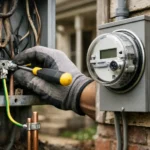
A lot of homeowners ask some version of the same question: Do modern smart PG&E meters give off micro wave pulses every three seconds, and are those waves at all dangerous to children, or elders? The short answer is that smart meters do use radio frequency signals, but the claim that they are constantly blasting dangerous microwave energy every three seconds does not match how these devices typically operate in the field. And based on the exposure levels involved, they are generally not considered a health danger to children, older adults, or other people in the home.
That said, people are right to ask. If a device is mounted on your house, transmits wirelessly, and runs all day, it is reasonable to want a straight answer instead of a sales pitch.
Do PG&E smart meters send out microwave pulses every three seconds?
Smart meters communicate using radio frequency, or RF, energy. That is part of the broad electromagnetic spectrum and includes the same general category of wireless communication used by things like Wi-Fi, cordless devices, and cell systems. Some people describe that as “microwave” radiation because certain RF frequencies fall in that range, but the word often creates more fear than clarity.
The bigger issue is the timing. The idea that every PG&E smart meter sends out a strong pulse every three seconds, nonstop, is oversimplified. Smart meters are not all identical, and utility communication systems vary by model, network design, and configuration. In practice, they usually send very short bursts of data rather than a continuous signal. Those bursts may happen at intervals, but the total transmission time across a full day is usually brief.
In other words, a meter can be active many times in a day without “broadcasting all day.” A short digital transmission is not the same as a steady, high-power emission.
What kind of waves are these?
The waves from a smart meter are non-ionizing radio frequency waves. That matters. Non-ionizing radiation does not have enough energy to break chemical bonds or damage DNA the way ionizing radiation can. X-rays and gamma rays are ionizing. Smart meter RF signals are not.
This does not mean people have to ignore all questions about exposure. It does mean the conversation should stay grounded in the actual physics. The main established effect of RF energy at high enough levels is heating. That is why microwave ovens are a separate issue entirely. A utility smart meter operates at a tiny fraction of that power and does not function like a microwave oven attached to your wall.
Are smart meter waves dangerous to children or elders?
For normal residential exposure, the evidence does not show smart meters posing a known health hazard to children or elders. That is the practical answer.
Children and older adults are often mentioned because people worry they may be more vulnerable. That is understandable. But the important question is exposure level, not just age group. Smart meter emissions are generally very low-power, intermittent, and subject to regulatory exposure limits. At the distances people usually occupy inside a home, exposure is typically far below those limits.
There is also a basic real-world point that gets missed. Distance matters a lot with RF exposure. The farther you are from the source, the lower the exposure. A meter is usually mounted outside, often on an exterior wall, and people are not standing with their body pressed against it for hours at a time.
That does not mean all homes are laid out the same way. In some houses, a bed, chair, or nursery wall may sit directly behind the meter location. If someone is worried, moving sleeping or sitting positions even a few feet can reduce exposure further. But that is a personal comfort measure, not an indication of proven danger.
Why the confusion keeps going
Part of the problem is that people hear a few technical words mixed together: radiation, pulses, wireless, microwave. Then the worst-case picture takes over.
Another problem is that many discussions fail to distinguish between hazard and exposure. Almost anything electrical creates some field or emission. Your panel, branch circuits, Wi-Fi router, induction cooktop, and cell phone all involve electromagnetic energy in one form or another. The real question is how much, how often, and at what distance.
A smart meter is not risk-free in the philosophical sense that no electrical device is truly risk-free. But when homeowners ask whether the radio signal from the meter is likely to harm their kids or elderly parents, the honest answer is that current evidence does not support that fear.
What actually deserves more attention than the meter signal
Homeowners sometimes focus hard on smart meter RF and miss more immediate electrical safety issues that are far more serious. In older East Bay homes, the bigger problems are usually deteriorated service equipment, overheated meter sockets, damaged service conductors, poor grounding, obsolete Federal Pacific or Zinsco panels, and unpermitted modifications.
Those are not theoretical concerns. Those are the kinds of defects that lead to arcing, nuisance tripping, burned bus bars, failed breakers, and real fire risk.
If you are standing outside looking at your PG&E meter and wondering about danger, it is worth also asking whether the meter base is rusted, whether the panel is outdated, whether the grounding system is correct, and whether the service is undersized for modern loads like air conditioning, induction cooking, and EV charging. Those issues usually matter much more to household safety than the meter’s wireless communication.
When it makes sense to ask questions
Even though the danger claims are often overstated, there are situations where a homeowner should ask for more information.
If someone in the house has a medical device, the right step is to check with the device manufacturer or physician about electromagnetic compatibility in general. That is not because PG&E smart meters are known to be dangerous, but because medical-device guidance should come from the people responsible for that equipment.
If the meter appears damaged, loose, hot, buzzing, or scorched, that is an electrical problem, not a radio-frequency debate. A damaged meter socket or service connection needs prompt attention.
If you are buying an older home and the service equipment looks original, have the full service inspected. The meter, meter base, panel, grounding, and service conductors all work together. Focusing on one part while ignoring the rest can lead to bad decisions.
A practical way to think about smart meter exposure
Think of a smart meter like a low-power communication device that sends brief information packets. It is not a continuous heater. It is not an X-ray machine. It is not operating at the kind of power people imagine when they hear the word microwave.
Could the meter transmit many times per day? Yes. Could that sound alarming if someone counts every packet as a “pulse”? Yes. Does that automatically make it dangerous? No.
The better way to judge it is by total exposure, power level, duration, and distance. On those points, smart meter exposure in normal home use is generally low.
What homeowners should do if they are still concerned
If concern remains, the smart move is to separate emotion from measurement. Ask what meter model is installed. Ask how the communication system works. If needed, have a qualified professional inspect the service equipment so you know whether your concern is about RF communication or an actual electrical defect.
A lot of fear disappears once people see the difference between a radio transmission issue and a service-equipment problem. And if there is a real service problem, that is worth fixing right away.
For homeowners in older properties, especially where there are panel issues, meter socket deterioration, or pending service upgrades, this is where an experienced electrician matters. A contractor who works on PG&E-related service changes, meter/main equipment, grounding, and panel replacement can usually tell very quickly whether you are looking at a health scare from the internet or a genuine electrical safety problem on the wall.
The plain answer
So, do modern smart PG&E meters give off micro wave pulses every three seconds, and are those waves at all dangerous to children, or elders? Smart meters do emit brief RF signals, but the common version of that claim is usually exaggerated, and the exposure levels involved are generally not considered dangerous for children or older adults.
If you want to protect your family, the more useful place to focus is the condition of the meter base, panel, grounding, and overall electrical service. In many homes, that is where the real safety decisions are.