When lights flicker in one lamp, that is usually a bulb or fixture problem. When lights flicker in many rooms in the house, the question becomes bigger: Why do my lights flicker in many rooms in the house? Is it a loose hot strand? PG&E at the weatherhead or pole or meter base causing it? Do I ask PG&E for a beast test? What is a beast test? Is it due to a bad main breaker, or a bad panel? At that point, you are no longer looking at a nuisance. You may be looking at a service problem, a failing connection, or a dangerous panel issue.
This is one of those symptoms homeowners should take seriously, especially in older East Bay homes with aging service equipment, Federal Pacific panels, Zinsco panels, old meter bases, aluminum connections, or weather-damaged overhead service conductors. Flickering in multiple rooms is often a clue that the trouble is upstream of the branch circuits.
Why lights flicker in many rooms instead of just one
If several rooms are affected at the same time, the problem is usually not one switch, one light fixture, or one branch circuit. It points more often to a loose or failing connection somewhere in the main electrical path. That path starts at the utility transformer and service drop, passes through the weatherhead and service conductors, into the meter base, through the main breaker or main lugs, and then into the panel bus.
A poor connection anywhere along that route can cause voltage fluctuations. Those fluctuations show up as lights dimming, brightening, or flickering across different parts of the house. Sometimes it gets worse when large loads turn on, like an air conditioner, microwave, electric dryer, space heater, or EV charger.
There is an important distinction here. If all the lights flicker together, suspect the service. If one side of the house gets brighter while another side gets dimmer, that can point to a failing neutral connection, which is more serious and can damage appliances.
Could it be a loose hot strand?
Yes, it could. A loose hot conductor at the panel, meter, weatherhead, or utility connection can create intermittent voltage drop and arcing. Some people describe this as a loose hot strand, but in the field the real issue is usually a loose termination, a damaged conductor, corrosion, or a partially burned connection point.
That kind of problem does not fix itself. It usually gets worse with heat, load, and time. As current flows through a poor connection, resistance rises. That creates more heat, more damage, and more flicker. In bad cases, you may hear buzzing at the panel or meter, smell overheating insulation, or see breakers that look discolored.
A loose hot is possible, but a loose neutral is often even more dangerous because it can produce uneven voltage on the two legs of a 120/240-volt service. That is when one group of lights may brighten abnormally while others dim.
Can PG&E at the weatherhead, pole, or meter base cause flickering?
Yes. Utility-side problems are real, and they are not rare. The trouble may be at the pole connection, the service drop splice, the transformer, or the utility side of the meter. It can also be at the weatherhead if the service conductors or connections have deteriorated.
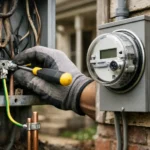
The meter base itself is a split-responsibility area. In many cases, the utility owns the meter, but the homeowner owns the meter socket, mast, weatherhead, and attached service equipment. That means flickering can involve both PG&E and your electrician. One party may need to inspect and rule out its side before the other can proceed.
This is why experienced troubleshooting matters. You do not want finger-pointing between the utility and the contractor while a dangerous connection keeps heating up. A qualified electrician can inspect the panel, meter base, grounding, service conductors, and load behavior, then tell you whether the evidence points to the utility side, the customer side, or both.
What is a BEAST test?
People often ask for a beast test, but what they usually mean is a utility load test or service investigation for a bad connection. In local conversation, terms get mixed up. The key point is not the nickname. The key point is asking PG&E to check for a loose service connection, failing splice, bad neutral, voltage drop, or transformer-side issue affecting the house.
If you call PG&E, describe the symptoms clearly. Tell them the lights flicker in multiple rooms, whether appliances also act strangely, whether it happens under load, and whether one side brightens while another dims. That gives them better information than simply saying the lights blink.
If you suspect utility involvement, ask them to inspect their side of the service and check for loose or burned connections at the pole, service drop, and meter. If they find nothing wrong on their side, the next step is a thorough electrician inspection of the customer-owned equipment.
Is it a bad main breaker or a bad panel?
It can be. A failing main breaker can cause flickering, intermittent voltage loss, heat damage, and poor contact under load. So can a bad panel bus, burned stab connection, overheated lug, or corrosion where the main breaker lands.
Older panels are a common source of these problems. Federal Pacific and Zinsco equipment deserve extra caution because both have a long history of failure issues. Even if the flicker turns out to be one loose lug, the presence of an unsafe or obsolete panel may still justify replacement. A panel that is already running hot, showing rust, or using breakers that do not seat properly is not a good candidate for patchwork repair.
A bad panel does not always fail by tripping breakers. Sometimes it fails by not tripping, by overheating internally, or by making weak contact. That is why lights flickering in many rooms should never be brushed off as normal house behavior.
Signs the problem is more urgent than it looks
If the flicker is occasional and mild, homeowners tend to wait. That is risky. Service connection problems can move from annoying to dangerous fast.
Take it seriously if you notice any of these at the same time: buzzing at the panel or meter, a hot electrical smell, breakers that feel unusually warm, lights getting very bright for a moment, electronics resetting, or dimming that happens when major appliances start. Another red flag is a panel brand with known safety issues, especially Federal Pacific or Zinsco.
A neutral problem deserves special attention because it can overvoltage part of the house. That can damage TVs, refrigerators, computers, LED lighting, and chargers long before a breaker trips.
What an electrician should check first
A proper diagnosis starts with the service equipment, not by randomly changing breakers. The electrician should inspect the panel condition, main breaker, bus bars, service conductor terminations, meter base, grounding and bonding, and visible signs of heat or corrosion. Voltage testing under load is also important because some failures only show up when the house is drawing current.
In some cases, the panel cover comes off and the problem is obvious – burned insulation, a loose lug, aluminum oxidation, a breaker that has overheated, or damage where the main lands on the bus. In other cases, the electrician may determine the house side looks sound and advise you to call PG&E to inspect the utility side immediately.
This is not good DIY territory. The parts involved stay energized even when branch breakers are off. Meter bases, service conductors, and main lugs can present serious shock and arc hazards.
Should you call PG&E first or an electrician first?
It depends on the symptoms. If you have obvious signs of utility trouble – flicker affecting the whole house, neighborhood voltage issues, service drop movement, or signs at the pole or weatherhead – calling PG&E first makes sense. If the panel is old, damaged, buzzing, or showing heat, an electrician should inspect it right away.
In many cases, the fastest path is both. Call PG&E to report multi-room flickering and possible service connection trouble. At the same time, schedule a licensed electrician who knows panel replacement, meter-main work, and service troubleshooting. That is especially true if your home has older gear or a history of panel problems.
For homeowners in Oakland, Berkeley, Piedmont, or nearby older neighborhoods, this comes up often because many houses still have aging service equipment that was never designed for today’s electrical loads.
The most likely causes, in plain terms
When lights flicker in many rooms, the usual suspects are a loose or failing utility connection, a bad neutral, a deteriorated weatherhead or service conductor, a damaged meter base, a failing main breaker, or a bad panel bus connection. Less often, it is a branch-circuit issue happening in several rooms by coincidence.
The right fix depends on where the fault is. If it is on the utility side, PG&E repairs it. If it is in the meter base, panel, breaker, grounding, or customer-owned service conductors, that is electrician work. If the panel is unsafe or obsolete, replacement is often the smarter repair than trying to save failing equipment.
Geoff Williams has been handling this kind of service and panel troubleshooting since the 1980s, including dangerous legacy panels and PG&E-related service equipment issues. The main point for any homeowner is simple: if multiple rooms are flickering, do not guess and do not wait for it to get worse. Have the service and panel checked before a flicker turns into burned equipment or a full outage.